Raffia vs Paper Straw Hats: A Material Guide for Brands
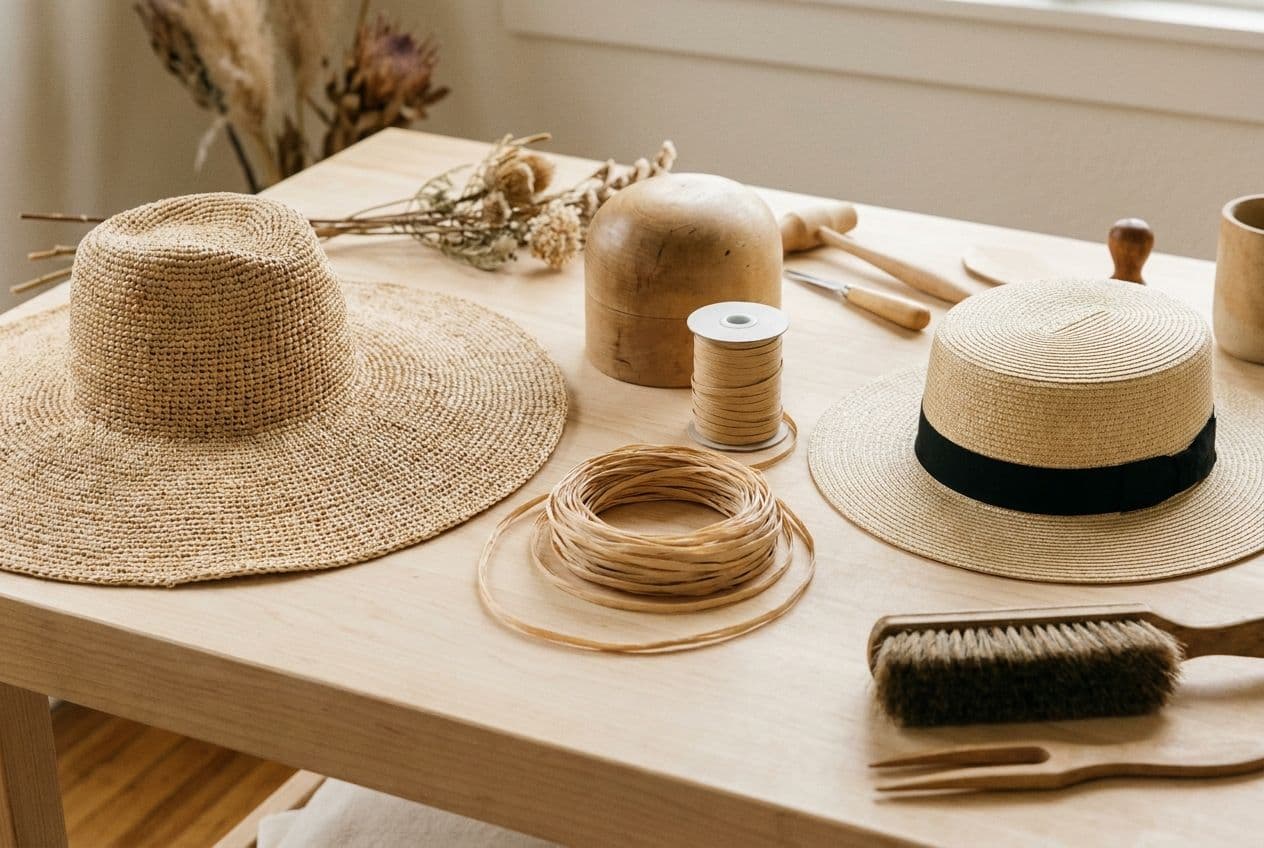
Most of what is sold as a "straw hat" contains no cereal straw at all. The word describes a look — a woven, natural-looking hat for sun and summer — and the material underneath is usually one of two things: natural raffia, or paper made into a braid. Both are legitimate, both make good hats, and they behave very differently in production, in the customer's suitcase and in the rain.
This guide explains the two materials we work with, how each is made into a hat, what you can customise, and how to choose between them for a summer program. If you are still deciding which hat shapes to carry at all, start with our guide to types of hats and caps.
The Short Answer
Choose raffia when the hat needs to feel natural and premium, survive being crushed into a bag, and tolerate the odd splash. Choose paper braid when you need crisp shape, very consistent colour across a large run, a lighter hat, and a lower unit cost — and when the hat will be worn in dry weather.
Natural Raffia
Raffia is a fibre stripped from the leaves of the raffia palm. Woven into a hat, it is soft, slightly glossy and pliable, with small natural variations in tone and strand width that customers read as a sign of a natural product.
What raffia does well:
- Packability. Raffia is flexible enough to be rolled or folded and recover its shape, which is why it is the usual choice for crushable and travel hats.
- Hand-feel. It feels soft against the hand and looks natural even at a distance.
- Dyeing. Raffia takes dye well. When it is dyed before weaving, colour runs through the strand, so wear does not expose a different colour underneath.
- Tolerance of damp. It is more forgiving of humidity and an occasional splash than paper — though no straw hat should be sold as rainwear.
What to plan for: natural variation. Two raffia hats from the same order will not be visually identical, and your quality standard should say how much variation is acceptable. Hand-woven raffia shapes also take longer to produce than braid-based ones.
Our raffia styles include the Wide Brim Raffia Sun Hat, the Woven Straw Sun Hat and the Straw Woven Sun Visor.
Paper Braid
Paper straw is made by twisting paper into a fine yarn and braiding it into a continuous tape. The braid is then formed into a hat — and because it starts as a manufactured material, it is far more uniform than any natural fibre. In the trade you will sometimes see it called "toyo" straw; "Panama-style" hats at accessible price points are very often paper braid, too.
What paper braid does well:
- Consistency. Colour, texture and strand width are almost identical across a run. For programs where every hat on a retail wall should match, this matters more than anything else.
- Shape. Paper braid holds a crisp crown and a clean brim edge well, which suits structured shapes like boaters and fedoras.
- Weight and cost. Paper hats are light on the head, and the material is economical to colour-match across a large quantity.
- Colour range. Dyed tones, two-tone braids and stripes are straightforward.
What to plan for: water. Paper braid softens and can deform if soaked, and a hat that has lost its shape rarely recovers fully. It is a dry-weather product; a water-repellent finish helps with splashes, but it does not make the hat rain-proof.
Our paper and packable styles include the Paper Braid Sun Visor Hat, the Packable Straw Fedora and the Foldable Straw Boater Hat.
Side by Side
| Raffia | Paper braid | |
|---|---|---|
| Look | Soft, slightly glossy, visibly natural | Matte, crisp and uniform |
| Consistency across a run | Natural variation in tone and texture | Very high |
| Packability | Excellent; recovers after crushing | Good when designed as foldable; can crease |
| Shape retention | Relaxed; suits floppy and wide-brim shapes | Crisp; suits boaters and fedoras |
| Water | More forgiving of damp | Softens when soaked |
| Weight | Light | Very light |
| Unit cost | Higher | Lower |
| Typical lead time | Longer for fully hand-woven shapes | Shorter for braid-based shapes |
Other Straws You Will See — and That We Do Not Make
Buyers comparing suppliers will also come across wheat straw, seagrass and toquilla palm. Genuine Panama hats are woven from toquilla in Ecuador, and are a different product category and price point altogether. We do not produce hats in these materials. Our straw program is raffia and paper braid, and the comparison above is the one that applies to any order placed with us.
How a Straw Hat Is Made
There are two broad constructions, and they explain most of the difference in lead time.
Hand-woven or crocheted. The hat is woven to shape strand by strand. This is how most raffia hats are made, and it produces the most natural, flexible result. It is limited by weaving hours, which is why fully hand-woven styles take longer.
Sewn braid. A continuous braid is sewn in a spiral, starting at the centre of the crown and working outward to the brim edge. This is common for paper braid and produces an even, consistent structure quickly.
After construction, the hat is blocked: shaped over a form with heat, moisture and usually a light stiffener, which sets the crown and brim. How much stiffener is used decides whether the hat is crisp and structured or soft and packable — something to specify rather than leave to the factory's default. Finally, the trims go on: the inner sweatband, the outer band and any branding.
Fit and Sizing
Straw does not stretch the way a knit or a fabric cap does, so sizing is done through the inner band. Most straw hats are sold in one or two sizes with an adjuster — a drawstring or tape inside the sweatband — to fine-tune the fit. If you sell into markets with very different head-size distributions, decide early whether one adjustable size is enough or whether you need two. Our hat spec guide covers sizing in more detail.
Customisation and Branding
Because you cannot embroider or print cleanly onto a woven straw surface the way you can on a cotton cap, branding on straw hats almost always lives on the trims:
- Outer band. A grosgrain ribbon in your colour, a woven jacquard ribbon with your logo, or a printed ribbon. This is the most visible branding position and the most common.
- Leather or PU patch on the band.
- Inner sweatband printed with your logo, or a woven label stitched inside.
- Hang tags and packaging.
Colour customisation is also straightforward: natural, bleached and dyed tones in both materials, and two-tone or striped braids in paper. A fully new weave pattern requires an extra sampling round. For the trade-offs between embroidered, woven and printed branding, see our custom logo branding guide.
Lead Times and Planning
Lead times on our straw hats vary by construction, and each product page lists its own. Braid-based and stocked-material styles run from around 7–25 days after sample approval; fully hand-woven shapes run longer, around 20–30 days. Sample MOQ is one piece; bulk MOQ starts at 200 pieces per style and colourway.
Straw hats are seasonal, and so is the weaving capacity behind them. Summer programs are best sampled in the autumn and confirmed by early in the new year, before spring orders compete for the same weaving hours. Our peak season planning guide explains how that queue builds.
Packing and Shipping
Straw hats are easy to damage in transit and easy to protect. Structured shapes should be nested, with crowns stuffed with tissue, and packed in rigid cartons that do not crush the brims. Natural fibres shipped by sea should be dry and packed with desiccant, which prevents musty smells and mould on arrival. Packable styles can travel flatter, but should still be packed in their intended folded shape. Our packaging guide covers carton marks and retail packaging options.
Bags to Match
Our straw hats share their weaving supply chain with the raffia and paper woven bags made by our bag brand, Sanjin Bag, so matching hat-and-bag sets can be developed together from the same fibre and dye references. See the straw woven bags and paper woven bags there, or browse our full straw and sun hat range.
Frequently Asked Questions
What is the difference between raffia and paper straw hats?
Raffia is a natural palm-leaf fibre: soft, packable, slightly glossy and naturally varied in tone. Paper straw is paper yarn braided into a tape: lighter, crisper, more uniform in colour and cheaper, but sensitive to water. Raffia suits crushable and premium hats; paper braid suits structured shapes and programs that need consistency at volume.
Are paper straw hats waterproof?
No. Paper braid softens and can lose its shape when soaked. A water-repellent finish improves splash resistance, but paper hats are designed for dry weather and should not be sold as rain-proof.
Can a raffia hat be folded or packed?
Yes. Raffia is flexible enough to be rolled or folded and recover its shape, which is why it is the usual choice for crushable travel hats. Paper braid hats can also be designed to fold, but they are more prone to creasing.
How do you put a logo on a straw hat?
Almost always on the trims rather than the straw itself: a woven, printed or grosgrain ribbon band, a leather or PU patch, a printed sweatband or an inside label, plus hang tags and packaging.
What is the MOQ for custom straw hats?
Sample MOQ is one piece. Bulk MOQ starts at 200 pieces per style and colourway.