Custom Bucket Hats: A Manufacturing Guide to Fabrics, Brims and Reversible Builds
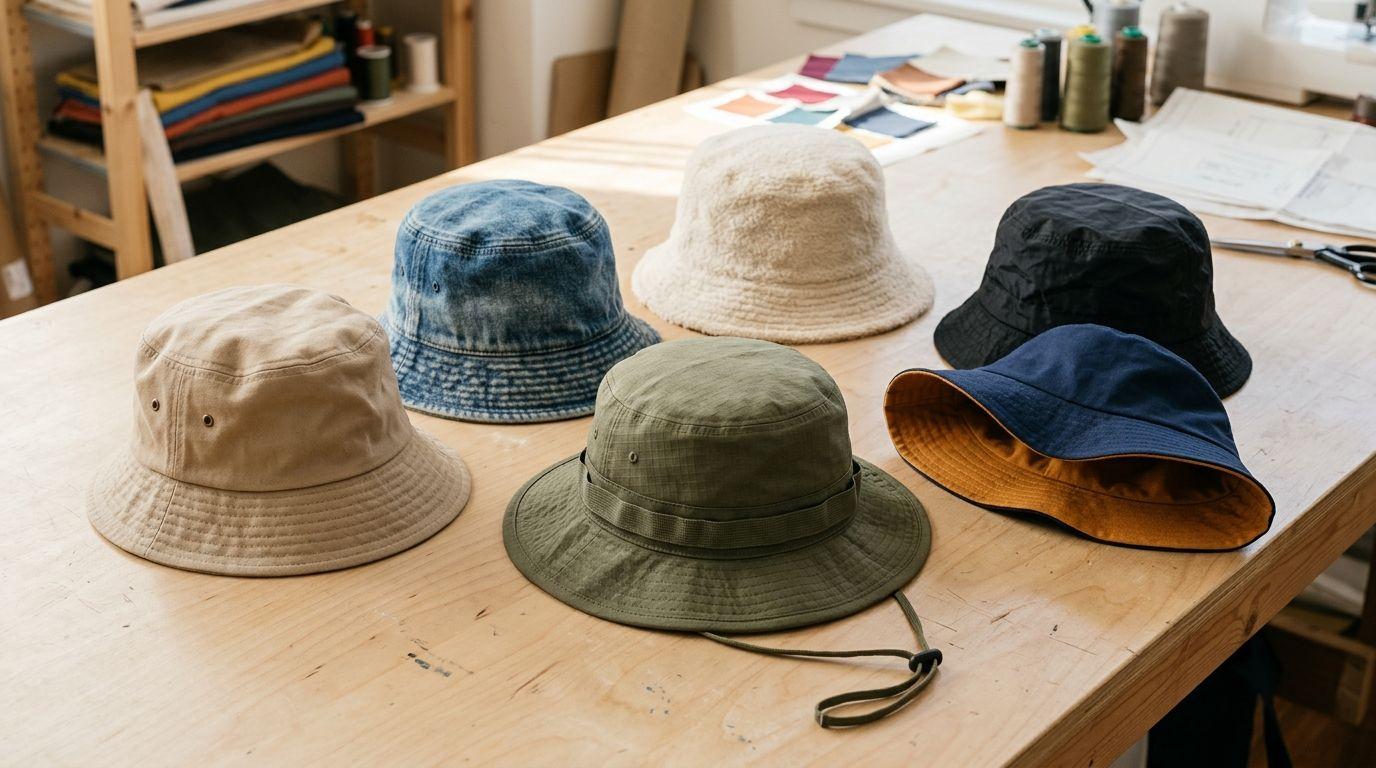
A bucket hat has almost nothing to hide behind. There is no front panel structure, no closure hardware and no mesh, just a crown and a downturned brim. That simplicity is why bucket hats work across streetwear, resort, outdoor and merchandise ranges, and it is also why small specification choices, such as how the brim is stiffened or how a reversible hat is joined, decide whether the finished hat looks sharp or limp.
This guide is for brands planning a custom bucket hat. It covers how the hat is built, which fabrics suit which market, how brims and reversible constructions differ, how to handle sizing, where branding goes, and what to put in your brief.
How a bucket hat is built
A bucket hat has three parts, each cut and specified separately:
- Crown top — the flat, usually oval piece at the top of the head.
- Side crown — the band that forms the sides of the hat, often made from several panels sewn together.
- Brim — the downturned ring around the base, cut as a flat ring or in sections and sewn to the side crown.
Inside, most single-layer hats have a lining or a sweatband, and a label carrying the size and care information. Optional details are metal eyelets for ventilation, a chin cord with a cord lock, and a packable or convertible design. For how bucket hats sit alongside caps, beanies and straw hats in a range, see our hat and cap types guide.
Choosing the fabric
| Fabric | Look and use | Notes |
|---|---|---|
| Cotton twill | The classic everyday bucket hat | Takes embroidery cleanly; the usual base for merchandise |
| Washed denim | Fashion and casual ranges | Wash shade is agreed on the sample and varies slightly by batch |
| Nylon | Lightweight, water-resistant, packable | Folds into its own pocket for travel and outdoor lines |
| Terry cloth | Beach, pool and resort | Soft and absorbent; brim needs topstitching to hold its shape |
| Bonded cotton canvas | Crisp, structured shape without extra interlining | Suits colour-block panels and reversible two-colour builds |
| Ripstop cotton-poly | Outdoor and boonie styles | Tear-resistant and holds a stiffened wide brim |
| Printed cotton | All-over pattern, often on a reversible hat | Stock patterns or your own artwork |
You can see these fabrics in our bucket hat range: the cotton twill bucket hat, denim bucket hat, nylon packable bucket hat, terry cloth bucket hat, colour-block bucket hat in bonded canvas, the boonie hat with chin cord in ripstop, and the reversible print bucket hat.
The brim: stiffness, width and angle
The brim decides the silhouette more than any other part. Three things are specified:
- Stiffness — rows of topstitching around the brim are the most common way to stiffen it, and more rows give a firmer brim. Bonded fabric or an interlining stiffens it further. An unstiffened brim flops and packs flat, which suits packable and beach hats.
- Width — a narrow brim reads as streetwear; a wide brim gives more sun cover and suits outdoor and resort ranges.
- Angle — how steeply the brim slopes down from the crown. A steeper angle gives a more classic bucket look; a flatter one sits closer to a sun hat.
Agree all three on the sample rather than from a drawing, because the same measurements can look quite different in two fabrics.
Reversible bucket hats: two constructions
A reversible hat gives two looks in one product, but it is effectively two hats sewn together, so it costs more than its simplicity suggests. There are two common ways to build one:
- Two complete shells joined at the brim. Each side is cut and sewn as a full hat, then the two are placed back to back and joined with topstitching around the brim edge. There is no visible lining on either side. This suits a printed side paired with a solid side, as on our reversible print bucket hat, or two bonded colours.
- A main shell with a fabric reverse. The reverse side is made from a lighter fabric, such as a nylon lining in a coordinating colour, as on our reversible two-tone bucket hat. It is lighter and packs more easily, but the reverse side looks more like a lining.
On a reversible hat, plan branding for both sides. A woven tag on each side or embroidery on the solid side are the usual options, because embroidery shows its back stitching on the other side if the hat is not built to hide it.
Sizing
Unlike a snapback cap, a bucket hat usually has no adjustable closure, so it has to be sized. As a typical reference, brands either offer two sizes, such as S/M and L/XL, or one size with some adjustability from a chin cord or an inner drawcord. Your size chart should give the head circumference for each size, and every size can be made to your own measurements. Children's ranges need their own size chart.
Each size is cut from its own pattern, so check whether your supplier counts sizes as part of one style or as separate styles for the minimum order.
Ventilation, chin cords and packable designs
- Eyelets — metal eyelets on the side crown add airflow, common on cotton twill, denim and outdoor hats.
- Chin cord — keeps a wide-brim or outdoor hat on in the wind; a cord lock makes it adjustable.
- Packable designs — a nylon hat that folds into its own pocket, or our convertible bucket hat bag, which cinches shut into a drawstring shoulder pouch. That style exists because bags and hats are made in the same factory.
Branding a bucket hat
The main logo positions are the front of the side crown, the brim edge and the inside. Common methods are direct embroidery, a woven or embroidered patch, a woven label sewn into the brim seam, a printed sweatband or inside label, and an all-over print in which the logo is part of the pattern. Embroidery works best on twill, canvas and denim; on terry and soft nylon a woven label or print usually looks cleaner. Our hat logo decoration guide compares each method in detail.
Colours, MOQ and lead time
Bucket hats are easy to colour-match to Pantone, and colour-block and reversible builds let you combine several colours in one hat. Each combination counts as a colourway with its own minimum, so plan colours across the range rather than style by style; our colourway and MOQ guide shows how.
Samples start from 1 piece, and bulk orders from 200 pieces per style. Bulk lead time is typically 7–25 days after sample approval, depending on the fabric, construction and quantity: a plain cotton twill hat sits at the shorter end, while reversible, colour-block and printed builds take longer.
A bucket hat brief checklist
- Fabric for each side (and lining, if any), with Pantone references or print artwork.
- Brim width, stiffness and angle, ideally with a reference hat or photo.
- Construction: single layer with lining, or reversible, and which method.
- Sizes and the head circumference for each, or one size with a chin cord or drawcord.
- Eyelets, chin cord or packable features.
- Logo artwork, method and position, for both sides if reversible.
- Quantity per colourway and size, and your target delivery date.
For a fuller template that covers every type of hat, see how to spec a custom hat.
Frequently Asked Questions
What is the difference between a bucket hat and a boonie hat?
A boonie hat is an outdoor version of the bucket hat. It usually has a wider, stiffer brim, a chin cord, ventilation eyelets and often a fabric loop band around the crown, and it is made in tougher fabrics such as ripstop. A standard bucket hat has a narrower, softer brim and is designed for everyday or fashion wear.
What fabric is best for a custom bucket hat?
Cotton twill is the most versatile choice and takes embroidery well. Choose nylon for a lightweight packable hat, terry cloth for beach and resort ranges, denim for fashion lines, bonded canvas for a crisp structured shape, and ripstop for outdoor styles.
How is a reversible bucket hat made?
Either as two complete shells sewn back to back and joined with topstitching around the brim, so neither side shows a lining, or as a main shell with a lighter fabric reverse such as a nylon lining. The first gives two equally finished sides; the second is lighter and packs more easily.
Do bucket hats come in sizes?
Usually, yes. Because bucket hats have no adjustable closure, brands typically offer two sizes such as S/M and L/XL, or one size with a chin cord or inner drawcord for adjustment. Sizes can be made to your own head-circumference chart.
What is the MOQ for custom bucket hats?
At Sanjin Manufacturing, samples start from 1 piece and bulk orders from 200 pieces per style. Bulk lead time is typically 7–25 days after sample approval, depending on fabric and construction.