Types of Hats and Caps: A Product Line Guide for Brands
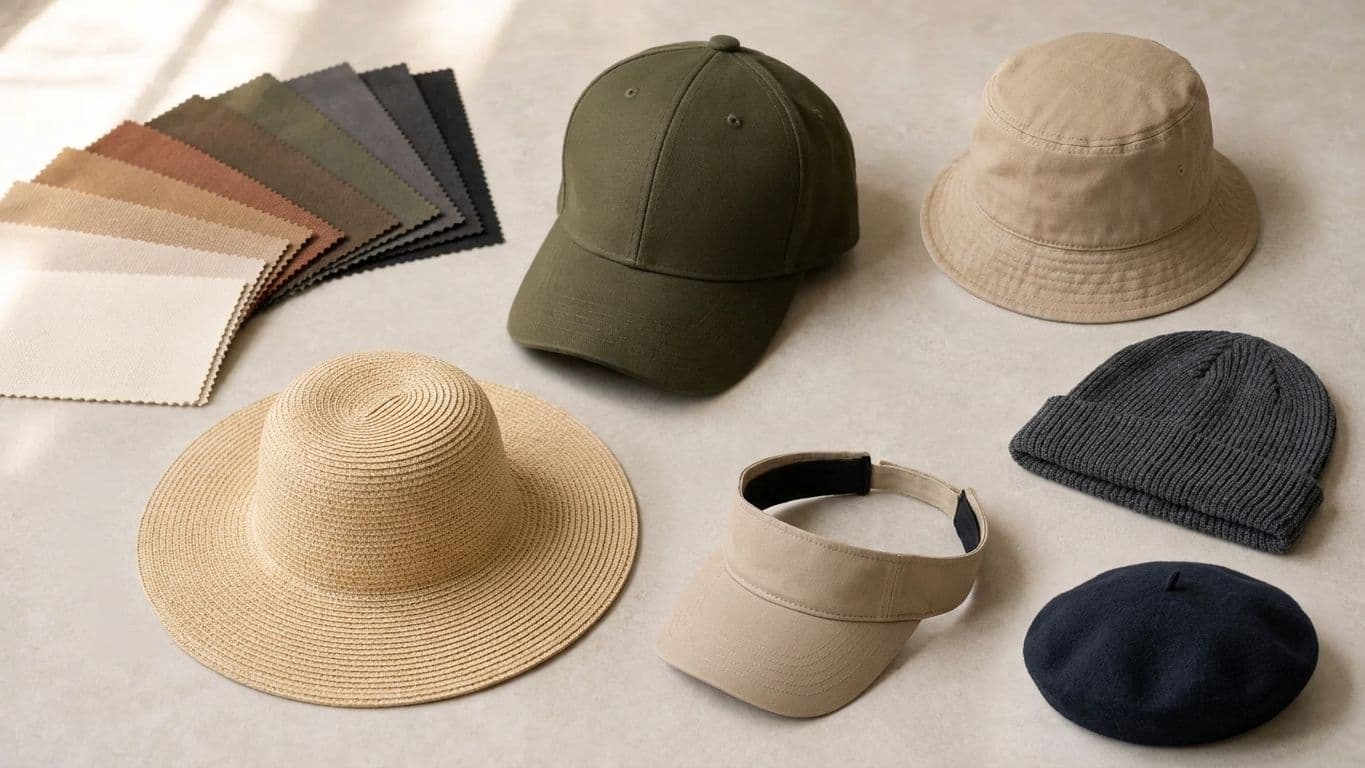
Most hat programs start with a mood board, not a spec. That is fine — but the six families below do not just look different, they behave differently in production. Panel count and brim curve cost nothing to change. Moving from a stitched cotton cap to a hand-woven straw body changes your lead time by three weeks and your branding options entirely. This guide covers what each family is, who it suits, and what it commits you to.
If you already know the style you want and need to write the spec sheet, go to How to Spec a Custom Hat instead. This page is the step before that one.
1. Structured Caps: Baseball, Dad, Trucker, Snapback, 5-Panel
This family covers most of what brands order, and the vocabulary around it causes most of the confusion. Four variables define almost every cap in it.
Profile: how tall the crown sits
| Profile | Crown height | Reads as |
|---|---|---|
| Low | ~3.5 in / 9 cm | Relaxed, vintage, fashion |
| Mid | ~3.75 in / 9.5 cm | Neutral, corporate, safe |
| High | ~4.5 in / 11.5 cm | Athletic, streetwear, trucker |
Brim: curved or flat
A curved brim is pre-shaped at the factory and reads casual and worn-in. A flat brim ships flat with the sticker left on and reads streetwear. The brim is a separate component either way, so the choice costs nothing — but it changes who the cap sells to more than any other single decision.
Put those two together and you have the term buyers most often search for without knowing it: a low-profile curved brim cap, unstructured, six panels, is what most people mean when they say "dad cap." We build it both ways — as the Low-Profile Curved Brim Cap with a brass buckle, and as the softer Unstructured Dad Hat.
Structured or unstructured
Structured caps carry a buckram panel behind the front two panels, so the crown stands up on its own and holds an embroidery area flat. Unstructured caps have no buckram; the crown collapses when the cap comes off. Embroidery on an unstructured front needs a smaller, lighter design, or it puckers.
If your logo is wide or detailed, specify structured — see the Structured 6-Panel Baseball Cap.
Panels and closures
Five-panel construction puts one continuous panel across the front, giving you an uninterrupted branding area with no centre seam. Six-panel splits it, which is why six-panel logos usually sit off-centre or straddle the seam. The Corduroy 5-Panel Cap is the camp-cap version of this.
Closures are a cost and sizing decision, not a style one:
- Strapback / buckle — adjustable, cheapest, works on any profile
- Snapback — plastic snap tape, high-profile flat-brim default, see the Graffiti Print Snapback Cap
- Velcro — promotional and workwear
- Fitted — no closure, but it forces you to carry multiple sizes per colorway, which multiplies your MOQ
Also in this family: the Mesh Trucker Cap (foam front, mesh back, the cheapest large branding surface in hats), the Imprint Rope Golf Cap, and the Legionnaire Cap with Neck Flap for outdoor and workwear programs.
Lead time for this family: 7–25 days after sample approval, depending on print complexity.
2. Bucket Hats and Boonies
Bucket hats are two fabric pieces — crown and brim — with the brim's stiffness doing all the work. A stiffened brim holds its downturn; an unstiffened one flops and packs flat.
- Cotton Twill Bucket Hat — the standard, embroiders well
- Nylon Packable Bucket Hat — crushes into a pocket, for travel and outdoor lines
- Denim Bucket Hat and Terry Cloth Bucket Hat — fashion and resort
- Reversible Two-Tone Bucket Hat — worth flagging that a reversible hat is two complete fabric specs in one unit, with no lining to hide construction. It costs more than it looks like it should
- Boonie Hat with Chin Cord — wider brim, eyelets, chin cord, for genuine sun exposure
One crossover style sits here and nowhere else: the Convertible Bucket Hat Bag, which cinches shut into a drawstring shoulder pouch. It exists because we run bags and hats in the same factory, and it is the one style in this guide a hat-only supplier cannot quote.
Lead time: 7–25 days.
3. Straw and Sun Hats: Where the Manufacturing Actually Changes
This is the family buyers underestimate. Every style above is cut-and-sew: fabric panels stitched together on a standard line. Straw hats are not, and the construction method decides your cost, your MOQ and your calendar.
Sewn braid vs. woven body
Sewn (stitched) braid starts with a continuous braid — paper straw, raffia, or toyo — that is coiled from the crown outward and machine-stitched into shape. Because the braid is made first and the shape second, results are repeatable unit to unit, brim width is easy to adjust, and the hat can be blocked into a fedora or boater profile. This is what people are searching for when they ask for a stitched paper braid hat. See the Paper Braid Sun Visor Hat and the Packable Straw Fedora, and the Foldable Straw Boater Hat for a flat-crown resort look.
Woven body means the hat is woven directly to its finished shape from natural straw or raffia, largely by hand. The open weave and the slight variation between pieces are the point — that is the look buyers pay for — but it also means more variation to allow for at inspection and a longer calendar. See the Woven Straw Sun Hat and the Wide-Brim Raffia Sun Hat.
What that costs you in time
| Style | Construction | Lead time |
|---|---|---|
| Paper Braid Sun Visor Hat | Sewn braid | 18–28 days |
| Woven Straw Sun Hat | Hand-woven body | 20–30 days |
| Cotton Twill Bucket Hat | Cut and sew | 10–20 days |
| Low-Profile Curved Brim Cap | Cut and sew | 7–25 days |
If a straw style is going into a spring or resort drop, it needs to be specified roughly a month earlier than the caps in the same collection. That single scheduling fact causes more missed launches than anything else in a hat program.
Branding on straw
You cannot embroider straw and you cannot screen print an open weave. The branding surface is the trim: a printed or woven ribbon band, an interior sweatband label, or a hang tag. Plan the logo around a ribbon from the start rather than discovering the constraint at sampling.
4. Knit Hats and Beanies
Knit is a different machine and a different set of variables: gauge (stitch density), fibre blend, and whether the hat is cuffed.
- Cuffed Knit Beanie — the default; the cuff is where a woven label or embroidered patch goes
- Oversized Slouchy Beanie — extra crown length, fashion
- Waffle Knit Beanie — textured stitch, reads premium
- Cable Knit Pom Beanie — poms are a separate component and a separate cost line
- Fleece-Lined Ribbed Beanie — lining is a second operation, add it only if the price point supports it
- Faux Fur Lined Trapper Hat — cold-weather, ear flaps, the most component-heavy item in the family
Branding on knit is a woven label, an embroidered patch, or a leather-look patch. Direct embroidery into a loose knit distorts; specify a patch instead.
Lead time: 7–25 days, longer for lined styles.
5. Felt, Wool and Newsboy Styles
A smaller family, but useful for autumn/winter collections and for brands that want something that does not read as promotional:
- Wool Blend Classic Beret and Wool Felt Artist Beret
- Leather-Trim Wool Beret
- Corduroy Newsboy Cap and Newsboy Cap with Snap Brim
- Wool Felt Outback Hat
Felt hats are blocked over a form rather than cut and sewn, so the crown shape is a tooling question. Standard blocks are free to use; a bespoke crown shape is not.
6. Visors
Visors are the cheapest entry point in the category — a brim, a sweatband and a closure, with no crown at all. They suit sports, golf, events and resort programs.
- Adjustable Sport Visor and UPF50 Running Visor
- Terry Cloth Tennis Visor
- Foldable Travel Visor
- Straw Woven Sun Visor
7. Branding Surface by Material
| Material | Embroidery | Screen print | Woven patch | Ribbon / label |
|---|---|---|---|---|
| Cotton twill | Best | Yes | Yes | Interior only |
| Mesh (trucker back) | Front panel only | Foam front | Yes | Interior only |
| Nylon / ripstop | Yes, light designs | Yes | Yes | Interior only |
| Knit | Patch preferred | No | Yes | Cuff label |
| Straw / paper braid | No | No | Limited | Primary surface |
| Wool felt | Yes | No | Yes | Interior only |
All-over print, and when it is worth it
Embroidery and patches brand a mark. All-over sublimation print brands the whole hat — the graphic is printed onto polyester fabric before the panels are cut, so it runs seam to seam with no placement limit. It only works on polyester (sublimation will not take on cotton or straw), it costs more per unit than a logo, and it needs artwork built to the panel pattern rather than a flat logo file. For drops, collabs and merch it is the strongest differentiator in the category.
8. What to Launch First
Bulk MOQ is 200 pieces per style and colorway, and sample MOQ is 1 piece. The number that matters there is the second one: colorways multiply your commitment, styles do not. Four styles in one colorway is the same 800 pieces as one style in four colorways, but it tells you far more about what your customers actually want.
A workable first drop for most brands is one structured cap (the volume driver), one bucket hat (the fashion piece), and one seasonal item — a beanie for autumn, a straw style for spring. Order all three as 1-piece samples first, approve them in hand, then commit the colorways to whichever performs.
If a straw style is in that list, start it a month before the rest.
Frequently Asked Questions
What is the difference between a dad cap and a baseball cap?
"Dad cap" is not a separate construction — it is a combination. It means a low-profile, unstructured, six-panel cap with a curved brim and an adjustable strapback. Any factory quoting a baseball cap can build it; you just have to specify those four things rather than the nickname.
What is a stitched paper braid hat?
A hat made by coiling a continuous braid of paper straw from the crown outward and machine-stitching the coils together, rather than weaving the body to shape. It gives a more consistent, repeatable result than hand-weaving and allows the hat to be blocked into a fedora or boater shape. Lead time runs 18–28 days.
What is the minimum order for custom hats?
One piece at sample pricing so you can approve construction and colour in hand, and 200 pieces per style and colorway for bulk production.
Which hat styles take the longest to produce?
Hand-woven straw, at 20–30 days after sample approval, followed by sewn paper braid at 18–28 days. Cut-and-sew caps and bucket hats run 7–25 days. Straw styles should be specified about a month ahead of the rest of the same collection.