How to Spec a Custom Hat: Panels, Profile, Closure, Fabric and Branding
Last updated: September 2026
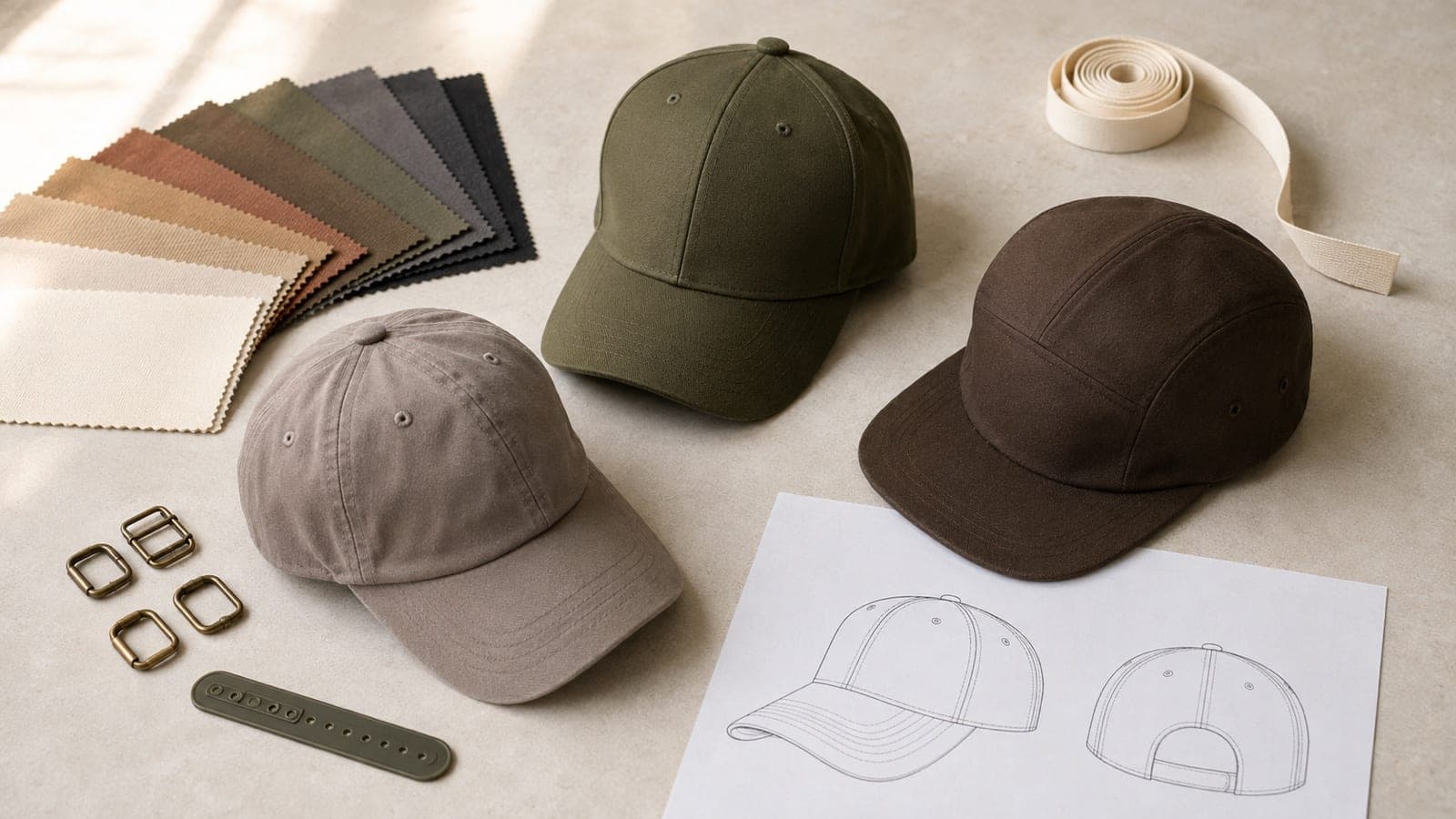
Most custom hat inquiries we receive say some version of the same thing: "I want a baseball cap with my logo embroidered on the front, black, around 500 pieces." That's a starting point, not a spec — and the gap between the two is where lead time gets lost and sample rounds pile up. A cap is a surprisingly specified product: panel count, crown height, brim curve, buckram, closure type, fabric weight, stitch density, sweatband, and eyelets are all separate decisions, and every one of them changes how the finished hat looks on a head. This guide walks through each decision in the order a factory actually needs them, so you can send one message that gets you a real quote instead of five rounds of questions.
1. Panel Count: What 5-Panel and 6-Panel Actually Change
Panel count describes how many pieces of fabric make up the crown of the hat, and it's the single decision that most defines the silhouette.
A 6-panel cap is the classic baseball construction: six triangular panels joined by seams, with a seam running down the center front. Because that front seam splits the panel, front embroidery on a 6-panel is usually placed on the two front panels together and needs to be centered carefully across the seam — or the design has to be small enough to sit inside one panel. The 6-panel shape holds a rounder, taller crown and is what most people picture when they say "baseball cap."
A 5-panel cap replaces the two front panels with a single seamless front panel. That gives you a flat, uninterrupted canvas for a logo, patch, or large print — which is why 5-panels are common for camp caps, skate and streetwear brands, and anything with a wide front graphic. The crown sits flatter and slightly boxier.
You'll also see 7-panel (a taller crown with an extra seam, often a premium streetwear look) and unstructured 6-panel dad caps, which use the same panel layout but skip the stiffening. Panel count on its own doesn't change price much; what changes cost is the structure and the branding method that goes on top of it.
2. Structured vs. Unstructured, and Crown Height
This is the decision buyers most often leave out, and it's the one that most affects whether a sample looks like what they imagined.
Structured caps use buckram — a stiffened fabric interlining sewn into the front panels — so the crown stands up on its own even off the head. This is the classic trucker/baseball look, and it's what you want if the front of the hat needs to hold a large embroidered logo flat and upright.
Unstructured caps have no buckram. The crown collapses softly against the head, giving the low-profile "dad cap" look. Unstructured caps are more forgiving to wear, but a large embroidery on the front will pull and pucker the fabric more visibly, so designs are usually kept smaller or moved to a patch.
Crown height is measured at the center front, from the sweatband seam to the top button. A high-profile crown runs roughly 12–14 cm, mid-profile around 10–11 cm, and low-profile around 8–9 cm. State the profile you want in words and give a target measurement — "low profile" means different things to different factories, but 9 cm doesn't.
3. Brim: Curve, Length, and Stiffness
The brim (or visor) is a separate spec from the crown. Three things to state:
- Curve — flat, pre-curved, or fully curved. Flat brims read as streetwear and snapback; pre-curved is the standard retail baseball look; a deep curve reads as vintage or sport.
- Length — typically 6.5–7.5 cm from the crown seam to the tip. Longer brims read as sportier and give more sun coverage.
- Stitch rows — the visible topstitching on the brim, usually specified as a number of rows (commonly 4, 6, or 8). More rows stiffen the brim slightly and are a visible design element in their own right.
Also state whether the brim insert should be plastic (holds shape, standard) or a softer material, and whether the underside fabric matches the crown or contrasts — an under-brim in a contrasting color is a cheap way to add a design detail without adding a branding operation.
4. Fabric and Weight
Fabric drives both the look and the price more than any other line on the spec. The most common choices for caps:
- Cotton twill — the default. Specify weight in ounces or grams; a heavier twill holds structure better and feels more premium. This is where a lot of quote differences hide: two factories quoting "cotton twill" may be pricing very different weights.
- Brushed cotton — softer hand, popular for dad caps and unstructured styles.
- Cotton/poly blends and polyester — cheaper, more colorfast, quicker-drying; the usual choice for sport and performance caps.
- Corduroy, canvas, denim, ripstop — seasonal and fashion options that change the sewing time and therefore the unit price.
- Mesh back — for trucker caps, specify whether the mesh is soft or stiff, and its color relative to the front panels.
- Straw and raffia — for sun hats and fedoras, a different production process entirely from sewn caps, with its own minimums and lead times.
If you have a sustainability requirement, say so at the quoting stage rather than after sampling. Recycled polyester and organic cotton exist for caps, but they need to be sourced against a certification chain — you can read more about how that works in our guide to sustainable materials and GRS certification.
5. Closure Type
The back closure is a visible design decision and affects sizing, so it belongs in the first message, not the third:
- Snapback — plastic snap strip, adjustable, flat-brim streetwear association.
- Velcro / hook-and-loop — inexpensive, very common on promotional and corporate caps.
- Metal buckle (with tuck-in tail) — a classic dad-cap closure that reads more premium.
- Leather or PU strap with buckle — a step up again in perceived value; specify the strap material and hardware finish.
- Elastic band or fitted — no adjustment. A fitted cap means you now need a size run (S/M, L/XL, or numbered sizes), which multiplies your order into several SKUs. Decide this early, because it changes the whole quantity structure.
- Cord lock / rope — common on 5-panel camp caps.
6. Branding: Embroidery, Patch, or Print
The branding method changes both the setup cost and how your logo actually renders at cap scale.
3D puff embroidery raises the stitching over a foam base for a bold, dimensional front logo. It works best on simple, bold shapes — thin lines and small text lose definition when raised.
Flat embroidery handles more detail than puff and is the workhorse for front, side, and back logos. There's still a floor on how small text can go before the stitches merge; as a rule, plan for letters no smaller than about 5 mm tall, and send vector artwork so the factory can digitize it properly.
Woven or leather patches carry fine detail and small text far better than embroidery, and are the right call for logos with gradients, thin type, or many colors. A patch adds a component to source, so factor in its own lead time.
Screen printing and heat transfer are used mainly on performance fabrics and on the flat front of 5-panels, where a print can cover more area than embroidery economically.
Whichever you choose, expect a one-time setup charge for embroidery digitizing or screen preparation, and expect to approve a strike-off or embroidery sample before bulk. Our full breakdown of the tradeoffs is in embroidery vs. screen printing vs. woven labels.
7. The Details Buyers Forget
These small items rarely appear in a first inquiry, and each one causes a round of back-and-forth if it's left blank:
- Eyelets — embroidered or metal, and how many per panel. Embroidered eyelets are standard; metal eyelets are a visible design choice.
- Button and squatchee — the fabric-covered button at the top of the crown; specify whether it's matching or contrast.
- Sweatband — cotton, poly, or moisture-wicking; and whether you want your brand printed on the inside of it.
- Taping — the fabric tape covering the interior seams. A contrast taping is a low-cost way to make an inexpensive cap feel considered.
- Labels — main woven label, care/content label, and any country-of-origin or fiber-content wording your destination market legally requires.
- Stitching color — matching or contrast, per seam. Contrast stitching is free-ish and changes the whole look.
- Packing — individual polybag, header card, hangtag, and how many caps per carton. See our packaging and private label guide for what to specify here.
8. A Spec Sheet You Can Copy
Send this filled in, with reference photos, and you can usually skip two rounds of questions:
| Style | 6-panel structured baseball cap |
| Crown height | Mid profile, ~11 cm center front |
| Brim | Pre-curved, 7 cm, 6 rows topstitching, matching under-brim |
| Fabric | 100% cotton twill, mid-heavy weight, color to Pantone (state code) |
| Closure | Metal buckle with tuck-in, antique brass finish |
| Front branding | 3D puff embroidery, 2 colors, ~6 cm wide (vector file attached) |
| Back branding | Flat embroidery, 1 color, ~3 cm wide |
| Eyelets | Embroidered, matching crown |
| Sweatband | Cotton, brand name printed inside |
| Taping | Contrast, color to confirm on sample |
| Labels | Woven main label + care label (US market wording) |
| Packing | Individual polybag with hangtag, 100 pcs/carton |
| Quantity | Per colorway, and total across colors |
Two notes on that last line. Quote quantity per colorway, not just in total — a fabric dye lot has its own minimum, so 1,000 caps in one color and 1,000 caps across ten colors are very different orders. And if you're ordering fitted rather than adjustable, list the quantity per size as well.
9. Sampling and Timeline
A realistic custom cap timeline runs roughly: 1–2 days to digitize artwork and confirm the spec, 7–12 days for a sample once fabric is on hand (longer if a custom-dyed fabric or a sourced patch is involved), a round of sample revisions if anything needs adjusting, then bulk production once the sample is approved and deposit received. Add shipping on top, and add buffer if your order lands in peak season — we've written about how to plan around that in our peak season capacity guide.
The most common cause of a blown timeline isn't the factory being slow. It's a spec that arrived incomplete, so sampling started against an assumption that turned out to be wrong. Every field you fill in above removes a guess.
Frequently Asked Questions
What's the difference between a 5-panel and a 6-panel cap?
A 6-panel cap has a seam running down the center of the front, while a 5-panel has a single seamless front panel. The practical consequence is branding: a 5-panel gives you a flat, uninterrupted area for a large logo or patch, while a 6-panel requires front embroidery to be centered across the seam or kept small enough to fit within one panel. The 6-panel also holds a rounder, taller crown; the 5-panel sits flatter.
Should I choose a structured or unstructured cap?
Choose structured if the front of the cap needs to hold a large logo flat and upright, or if you want the crown to stand up on its own — the classic baseball silhouette. Choose unstructured for the softer, low-profile dad-cap look. Keep in mind that large embroidery on an unstructured front panel tends to pucker the fabric, so unstructured designs usually use smaller embroidery or a patch.
Is embroidery or a woven patch better for my logo?
It depends on the logo. Embroidery suits bold, simple shapes and text down to roughly 5 mm letter height. If your logo has thin lines, small type, gradients, or many colors, a woven or leather patch will reproduce it far more faithfully — embroidery stitches merge at fine detail. Patches add a sourced component, so build a little extra lead time in.
Do I need to order the same quantity in every color?
No, but be aware that each color has its own fabric dye minimum, so a small run in an eleventh color can carry a disproportionate cost. Quote quantities per colorway rather than as one total, and ask the factory where the dye-lot break points fall — often you can rebalance quantities across colors and lower your overall cost without changing the total order size.
What should I send along with my spec sheet?
Vector artwork for every logo (AI, EPS, or PDF — not a JPEG pulled from a website), Pantone codes for every color you care about, and reference photos of caps whose shape or detail you want matched. Reference photos are underrated: a single photo of the crown profile you have in mind settles a conversation that words often don't.
Working on a cap program and want the spec pressure-tested before you commit to sampling? Send us what you have — we'll tell you what's missing, what will and won't work at cap scale, and what it costs to make.