Baseball Cap Classification: A Practical Taxonomy
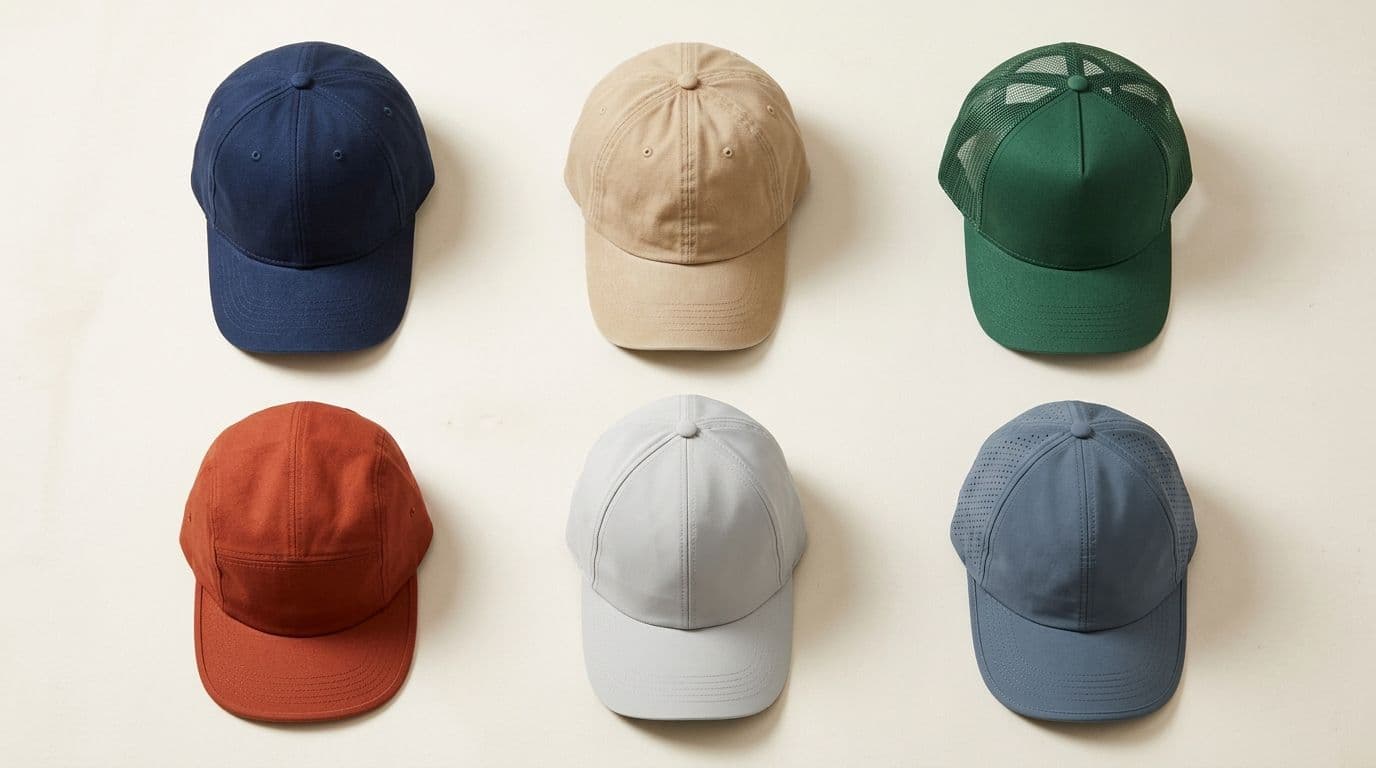
There is no official, industry-standard taxonomy for baseball caps. What works in practice, whether you are writing a spec for a factory or building a product catalogue, is to stop treating cap names as categories and to classify each style by its structural attributes instead. Six attributes describe almost every baseball-style cap, and decoration sits on top as a separate layer.
This guide sets out those six attributes, shows how the common names ("dad hat", "trucker", "snapback") map onto them, and gives a catalogue structure and naming scheme that keeps a range consistent as it grows.
Why cap names make poor categories
Cap names mix different kinds of information. "Trucker" describes the back material (mesh) and usually a structured foam front. "Snapback" describes only the closure. "Dad hat" describes a relaxed, unstructured, low-profile look. "Camp cap" describes a flat brim and a five-panel shape.
Because the names answer different questions, they overlap. A snapback can be a trucker. A dad hat can have a metal slide buckle or a plastic snap. If all of these sit in one flat list, the same cap belongs in three categories, and a shopper who filters by "snapback" misses the trucker that happens to use one. Classifying by attributes removes the overlap, because each attribute answers exactly one question.
The six structural attributes
| Attribute | Typical values | What it changes |
|---|---|---|
| Panel count | 5-panel, 6-panel | A 5-panel cap has a single wide front panel with no centre seam, which leaves an uninterrupted area for a logo. A 6-panel cap has a seam down the centre front. |
| Crown structure | Structured (stiffened front, usually buckram or foam) or unstructured (soft, no front stiffener) | Shape retention, how the front panel holds a logo, and the materials and assembly the cap needs. |
| Profile (crown height) | Low, mid, high | How tall the cap sits on the head, and therefore its overall look and fit. |
| Brim | Flat, pre-curved or curved; length and stiffness | The silhouette from the side, and how the cap reads at a glance. |
| Closure | Plastic snapback, metal snapback, strap with buckle or slide, hook-and-loop, fitted or elastic | How adjustable the cap is, and how premium it feels at the back. |
| Fabric and back material | Cotton twill, chino, poplin, corduroy, polyester, bonded cotton canvas, mesh back | Hand-feel, season, weight and which decoration methods work. |
Most baseball-style caps are five-panel or six-panel, but other constructions exist, so treat the panel-count field as open-ended rather than a closed list.
Decoration is a seventh, separate layer: flat or 3D embroidery, woven, leather or rubber patches, screen print, heat transfer and sublimation. Which method suits which cap depends heavily on the attributes above; a raised logo behaves very differently on a structured front than on a soft one. We cover that in our guide to hat logo methods.
How common names map to the attributes
The names below are conventions, not standards, and the same name can mean slightly different things between brands. The right-hand column shows real styles from our own catalogue so you can see the attributes in practice.
| Common name | Usual attributes | Example from our catalogue |
|---|---|---|
| Baseball cap | 6-panel, structured, pre-curved brim, adjustable back | Structured 6-Panel Baseball Cap: buckram crown, pre-curved brim, metal snapback |
| Dad hat | Unstructured, low-profile, curved brim, strap closure | Unstructured Dad Hat: soft crown, self-fabric strap with brass slide buckle |
| Relaxed 6-panel | 6-panel, low-profile, curved brim, buckle closure | Low-Profile Curved Brim Cap: brass buckle, soft-washed cotton twill |
| Trucker | 5-panel, structured foam front, mesh back, snapback | Mesh Trucker Cap |
| Snapback | A closure type, usually found on structured caps | Graffiti Print Snapback Cap: structured 6-panel with plastic snapback |
| 5-panel camp cap | 5-panel, unstructured, low crown, short flat brim | Corduroy 5-Panel Camp Cap and Colour-Block 5-Panel Camp Cap |
| Golf cap | Structured 6-panel, pre-curved brim, moisture-wicking sweatband | Imprint Rope Golf Cap |
| Performance cap | Unstructured, lightweight polyester, perforated panels | Laser-Perforated Performance Cap |
You can see each of these styles in full on its product page: the structured 6-panel baseball cap, unstructured dad hat, low-profile curved brim cap, mesh trucker cap, graffiti print snapback cap, corduroy 5-panel camp cap, colour-block camp cap, imprint rope golf cap and laser-perforated performance cap.
Notice that "snapback" appears as a closure on two different rows. That is the point of the table: it is an attribute value, not a category.
A catalogue structure that avoids overlap
If you are building a catalogue or an inventory taxonomy, three levels cover it without the overlaps:
- Product family. Baseball caps, bucket hats, beanies and so on.
- Silhouette. One value per cap, chosen from a short list: for example structured baseball cap, dad hat (unstructured, low-profile), trucker, five-panel camp cap, golf cap and performance cap.
- Filterable attributes. Panel count, crown structure, profile, brim, closure and fabric, each stored as its own field and available as a filter.
Two rules keep this clean. Every cap has exactly one silhouette but any number of attribute values. And closure and fabric never become categories, because they cross every silhouette. As a rule of thumb, five to seven silhouettes is enough for a range; if you need more, you are probably encoding an attribute as a category.
For SKUs, build the code from the same attributes so that it can be read and sorted. One example convention (adapt the abbreviations to your own system):
| Part | Meaning | Example |
|---|---|---|
| CAP | Product family | CAP |
| 6P | Panel count | 6P |
| STR | Structure (STR structured, UNS unstructured) | STR |
| TWILL | Fabric | TWILL |
| MSNAP | Closure (MSNAP metal snapback, BUCKLE, VELCRO) | MSNAP |
| NAVY | Colour | NAVY |
A complete SKU reads CAP-6P-STR-TWILL-MSNAP-NAVY. Colour comes last because it changes most often; if you offer several colourways per style, see our guide to custom cap colourways and MOQ.
What this means when you brief a factory
The same logic applies when you send a request for quotation. If you write "dad hat", a supplier can reasonably choose several different constructions. If you write the six attributes, the quote matches what you meant, and the sample comes back right the first time.
Our guide to speccing a custom hat goes through each of the six decisions in the order a factory needs them and ends with a copyable spec sheet. For the wider range beyond baseball caps, such as bucket hats, beanies and straw hats, see Types of Hats and Caps.
Frequently Asked Questions
Is there an official classification system for baseball caps?
No. There is no formal industry standard, only conventions, and the same name can mean slightly different things between brands. The reliable approach is to describe a cap by its structural attributes (panel count, crown structure, profile, brim, closure and fabric) rather than by its marketing name.
What is the difference between a dad hat and a baseball cap?
The difference is construction rather than a formal category. A dad hat usually means an unstructured, low-profile cap with a curved brim and a strap-and-buckle closure. A classic baseball cap is usually structured, with a stiffened front and an adjustable snap or strap. Many catalogues file dad hats as a subtype of baseball caps.
Is a snapback a type of cap or a type of closure?
A snapback is a type of closure: a band at the back with snap fastenings that adjust the fit. It is most often found on structured caps, but it can appear on several different silhouettes, including trucker caps.
How many categories should an online catalogue use for caps?
As a rule of thumb, keep to five to seven silhouettes and use filters for everything else. More categories than that usually mean an attribute such as closure or fabric is being used as a category, which creates overlaps.
Can the same cap be filed under two categories?
It is better not to. Give each cap one silhouette and describe the rest with attribute fields. That way a filter such as "snapback" returns every cap with that closure, whatever its silhouette, and no cap appears twice in the category tree.