How Many Colourways for Custom Caps? MOQ, Pantone Matching and Range Planning
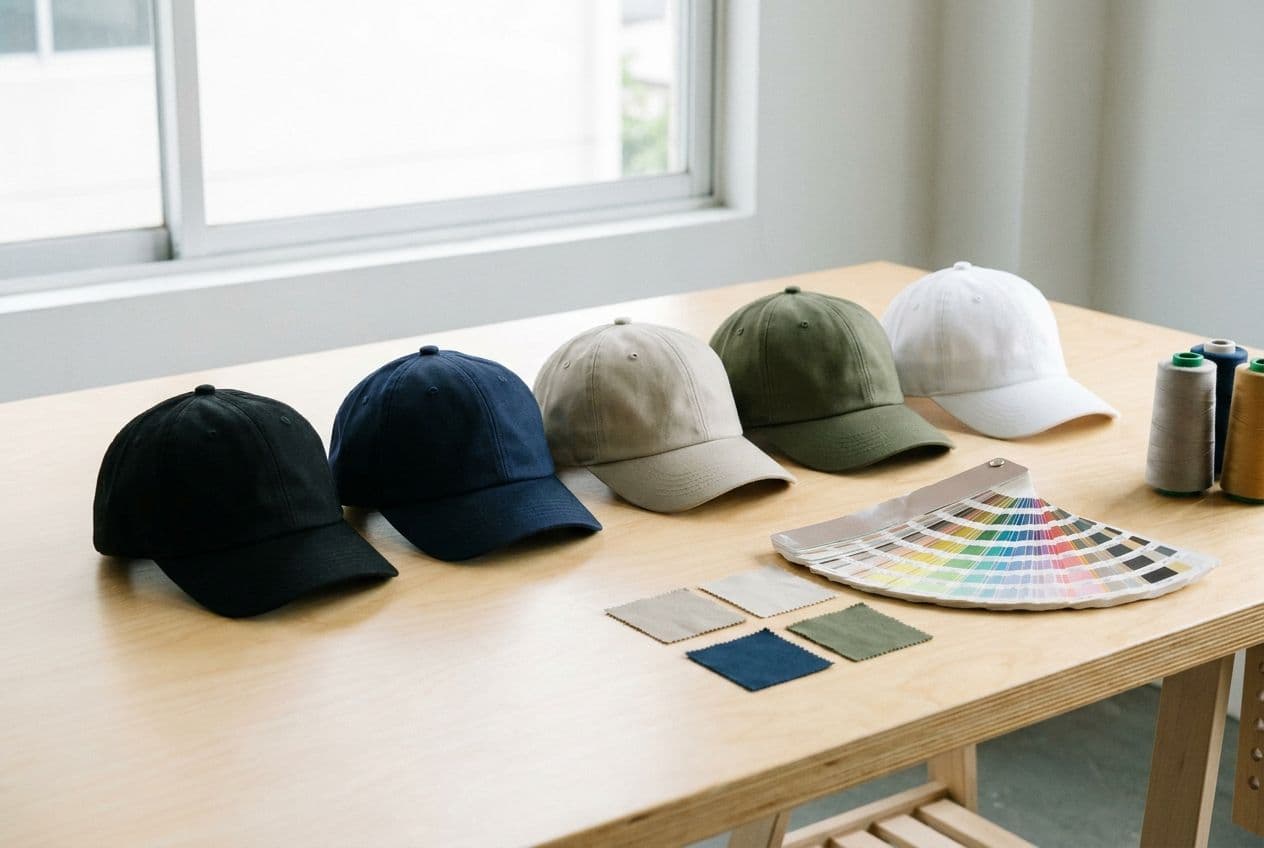
"How many colours should we order?" is one of the first questions on almost every custom cap project, and one of the easiest to get wrong. Too few colourways and the range looks thin on the shelf or the merch table. Too many and the order splits into small runs, the budget goes on sampling and lab dips, and half the colours sit in stock at the end of the season.
This guide explains how colourways work in custom cap production: what counts as a colourway, how minimums apply per colour, how colour matching works, and how to plan a range that sells through. If you have not yet settled the cap itself (panel count, structure, brim, closure), start with our guide on how to spec a custom hat, then come back to colour.
The Short Answer
For most first orders, two to four colourways per style is the right range. One core colour carries most of the volume (usually black, navy or a neutral), one or two secondary colours give the range depth, and an optional seasonal or statement colour tests demand. Plan quantities so that every colourway meets the bulk minimum on its own; at our factory that is 200 pieces per style and colourway.
What Counts as a Colourway
A colourway is one complete colour combination of a style. Change any visible colour and you have a new colourway:
- Crown and brim colour. A solid black cap and a black cap with a white brim are two colourways.
- Mesh or contrast panels. On a trucker cap, the front panel, mesh back and brim can each be a different colour.
- Trims. Sandwich brim, eyelets, top button, closure strap and taping all count if they change colour.
- Logo colours. A white logo on black and a black logo on white are two colourways, even on the same blank colour.
This matters because the minimum, the sample and the colour approval all apply per colourway, not per style.
How Minimums Work Per Colour
Bulk minimums apply to each colourway separately. A 600-piece order of one style can run as three colourways of 200 pieces, but not as six colourways of 100. The reason is practical: each colourway needs its own fabric cut, its own thread and trim set-up, and its own colour check at the line.
When you split an order across colours, plan the split from expected sales, not evenly. A common pattern for a three-colour range:
| Colourway role | Share of the order | Example |
|---|---|---|
| Core colour | 50-60% | Black or navy |
| Secondary colour | 25-30% | Stone, khaki or white |
| Seasonal / statement colour | 15-20% | Olive, burgundy or a brand colour |
If the statement colour cannot reach the minimum on its own, either move it to a later order or drop it. Splitting below the minimum is where unit costs climb.
Stock Colours vs. Custom Pantone Matching
There are two ways to get a colour.
Stock colours are fabrics already dyed and held by the mill or by us. They are the fastest and cheapest route, and the colour is fixed. Most of the caps in our catalogue show the stock colours we photograph most often, and more are available for each style.
Custom Pantone matching means the fabric is dyed to your reference, usually a Pantone TCX/TPX number or a physical swatch. The mill dyes a small swatch first, called a lab dip, which you approve before the bulk fabric is dyed. Custom matching adds a round of approval before production and may carry a dye-lot minimum on the fabric, which we confirm when we quote.
A few things to know about matching:
- Give a fabric reference, not a screen colour. A colour on a monitor or a print-on-paper Pantone chip will not match fabric exactly. A TCX/TPX textile reference or a physical swatch is far more reliable.
- Different materials take dye differently. Cotton twill, polyester mesh and a nylon brim dyed to the same Pantone can still look slightly different side by side. If two parts of the cap must match closely, say so in the brief.
- Approve under the right light. Check lab dips in daylight and under shop lighting; a colour can shift between the two.
Planning Colourways Across Styles
If you are buying several cap styles at once, coordinate colours across them rather than planning each style alone.
- Share a core palette. Running the same black, navy and stone across a structured 6-panel cap, an unstructured dad hat and a bucket hat means fabric and thread can be ordered together and the range looks consistent.
- Use contrast on one style only. A two-tone or mesh trucker cap is a good place for a contrast colour; it gives the range energy without adding colourways everywhere.
- Match the season. Light neutrals and brights sell through faster in spring and summer programs; darker tones in autumn and winter. A performance cap for running is usually ordered in black, white and one high-visibility colour.
Logo Colour Is Part of the Decision
The decoration method changes how many logo colours make sense:
- Embroidery handles several thread colours easily, but very small details in many colours lose definition.
- Screen printing costs more with each additional ink colour.
- Woven and rubber patches fix the colours into the patch, so every colourway of the cap can carry the same patch, or a patch recoloured for each.
A simple rule: decide one logo treatment that works on all your cap colours, or plan a light and a dark logo version from the start. Our custom logo and branding guide compares the methods in detail.
Sampling Colourways
You do not need a full sample in every colour. The usual approach:
- Make one full pre-production sample in the core colour to approve shape, fit and decoration.
- Approve the other colours by lab dip or fabric swatch plus a photo of the trims.
- Check one finished cap per colourway at the start of bulk production, before the full run.
This keeps sampling cost down while still catching colour problems before bulk.
A Colourway Checklist for Your Brief
- Number of colourways per style, and the role of each (core, secondary, statement)
- Quantity per colourway, each at or above the bulk minimum
- Colour reference for each part: crown, brim, mesh, undervisor, trims
- Stock colour or custom Pantone (TCX/TPX) for each
- Logo colours for each colourway
- Which colourways need a full sample and which can be approved by swatch
MOQ and Lead Time
Samples start from 1 piece. Bulk MOQ is 200 pieces per style and colourway. Lead time depends on the style: most cotton and polyester caps run 7-25 days after sample approval, and custom Pantone fabrics add the time needed to approve the lab dip and dye the bulk fabric.
Frequently Asked Questions
How many colourways should a custom cap order have?
For most first orders, two to four colourways per style: one core colour carrying most of the volume, one or two secondary colours, and an optional seasonal or statement colour. Each colourway should reach the bulk minimum on its own.
Is the MOQ per style or per colour?
Per style and colourway. At our factory the bulk minimum is 200 pieces for each colourway of each style, so a 600-piece order can run as three colours of 200 pieces.
What is a lab dip?
A small swatch of fabric dyed to your colour reference before bulk dyeing. You approve the lab dip, and the bulk fabric is then dyed to match it.
Can you match a Pantone colour exactly?
We dye to a Pantone TCX/TPX textile reference or a physical swatch and you approve the result by lab dip. Different materials take dye differently, so cotton, polyester mesh and nylon parts dyed to the same reference can vary slightly; tell us which parts must match closely.
Do I need a sample in every colour?
Usually not. Approve shape, fit and logo on one full sample in the core colour, then approve the other colours by lab dip or fabric swatch, and check one finished cap per colourway at the start of bulk production.