Bags and Hats from One Factory: How Capacity Actually Gets Scheduled
Last updated: September 2026
Buyers who order both bags and hats usually assume the two run on separate tracks that happen to share an address. Inside a factory that makes both, the picture is more entangled than that: some departments are genuinely shared, some are not, and the ones that are shared are usually the bottleneck. Knowing which is which changes how you place a combined order, what a realistic ship date looks like, and whether consolidating with one supplier actually saves you anything.
This is the scheduling reality from the factory floor side — not when to book a slot (that is the peak season capacity guide), but how work physically moves once your PO is in.
1. What the Two Categories Share, and What They Don't
A bag and a cap look nothing alike, but a large part of the process behind them is the same equipment and the same people.
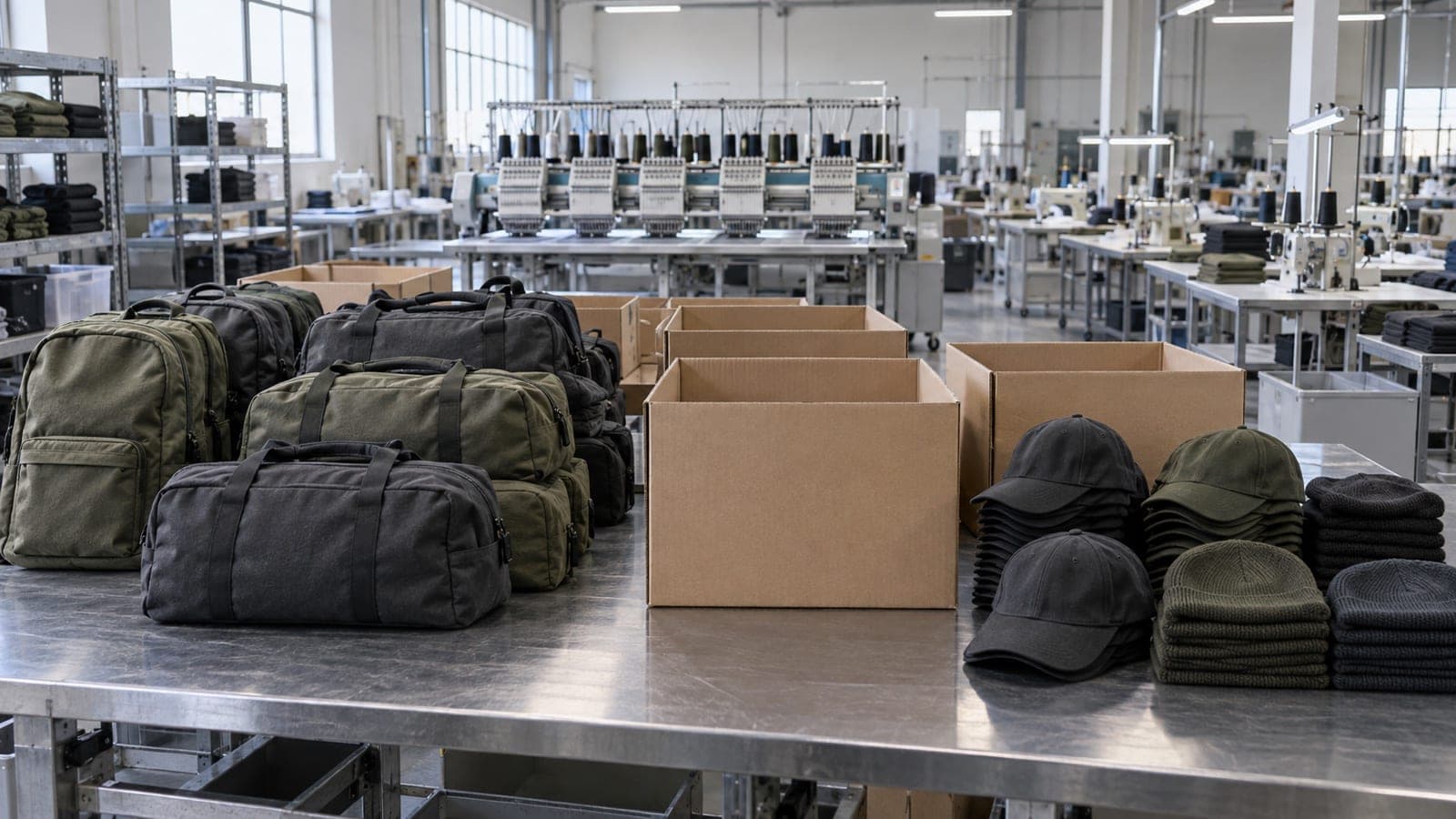
Genuinely shared: cutting, embroidery and printing, hardware and trim stores, quality control, and packing. A cutting table does not care whether the panel it is cutting becomes a backpack front or a cap crown. An embroidery head runs a logo onto a twill panel identically either way. Final inspection, cartonisation and loading are one department for the whole factory.
Not shared: the assembly lines themselves. Bag sewing is heavy work on long-arm and walking-foot machines, built around large panels, thick webbing and bar-tacking. Hat assembly runs on different equipment entirely — crown-closing, sweatband setting, brim curving, blocking and steaming. A worker who is fast on duffels is not usable on beanies that afternoon, and the machines do not swap.
The practical consequence: adding a hat SKU to a bag order does not compete for the same sewing capacity, but it does compete for the same embroidery, QC and packing capacity. That is where a combined order actually gets constrained.
2. Embroidery Is Usually the Real Bottleneck
Most buyers assume sewing is the limiting step, because sewing is what a factory tour shows off. On a mixed bags-and-hats order it is more often decoration.
Embroidery machines are counted in heads, and every branded piece in your order passes through them regardless of category. A cap front logo and a backpack chest logo queue on the same machines. Stitch count is what drives the time, not piece count — a dense 12,000-stitch crest takes several times longer per unit than a simple 3,000-stitch wordmark, so two orders of identical quantity can occupy the embroidery department for wildly different durations.
Two things follow from this that are worth acting on:
- Ask for a stitch count estimate when you approve artwork, not just a visual proof. It is the number that tells you what your decoration step will cost in both money and calendar time.
- Simplifying a logo is the cheapest schedule saving available to you. Reducing stitch density or dropping a background fill often shortens the decoration step materially without any visible loss at arm's length.
Where a design suits it, screen printing, heat transfer or a woven patch moves the work off the embroidery queue entirely. See the branding methods guide for what each one suits.
3. Line Changeover Is Not Free
A sewing line set up for one product is a physical configuration: machine settings, jigs and folders, the sequence of operators, and a workforce that has built up speed on that specific operation. Switching that line to a different product costs setup time and, more significantly, costs the learning curve — the first units off a newly changed line are slower and carry a higher defect rate than the last units off the previous run.
This is why quantity affects your unit price in steps rather than smoothly, and why it is generally cheaper to order 600 pieces of one colourway than 200 pieces each of three unrelated styles. It is also why a factory will often propose grouping your SKUs differently from how you listed them — usually by construction, not by colour or by the order they appear in your line sheet.
When a factory suggests a different production sequence than the one you asked for, it is normally trying to avoid changeovers. It is worth asking what the resequencing saves before insisting on your original order.
4. The Consolidation Trap: One Shipment Waits for the Slowest SKU
The main argument for buying bags and hats from one factory is consolidation: one supplier relationship, one QC standard, one set of documents, one container. Those savings are real. The cost that surprises people is timing.
Because bag and hat assembly run on separate lines at different rates, the two halves of a combined order rarely finish together. If everything ships as one consignment, your entire order lands on the finish date of whichever half is slower — and a small, awkward hat SKU can hold back a large bag order worth many times more.
Three ways to handle it, in order of how often they are the right answer:
- Size the categories to finish together. The cleanest fix and the one to ask about at quoting time: tell the factory your target ship date and let it advise what quantity split lands both halves on it.
- Split the shipment. Ship the finished half and follow with the second. You pay twice the freight and clear customs twice, so this only makes sense when the first half is urgent and large.
- Hold the fast half deliberately. Accept the later date and take the single-container saving. Often correct — but it should be a decision you made, not something you discover three weeks before your launch.
Whichever you choose, get the ship date written against the combined order rather than against each category separately. Two accurate per-category dates and no combined date is how this goes wrong.
5. Where a Multi-Category Factory Is Genuinely Better — and Where It Isn't
Consolidation is worth most when the two categories share more than a shipping container:
- Matching branding across categories. The same embroidery department running your cap logo and your bag logo means one thread standard and one approval, not two suppliers each interpreting a Pantone. Colour matching across categories is the single hardest thing to achieve across two vendors.
- Shared materials. If a cap and a bag use the same cotton twill, one fabric order hits the roll minimum once. Split across two factories, you buy two partial rolls at worse pricing.
- One compliance position. One BSCI and ISO 9001 audit trail covering the whole order rather than reconciling two suppliers' certificate scopes. See the certification guide.
It is worth less, and sometimes negative, when one category is a token quantity. A 200-piece hat order attached to a 5,000-piece bag order gets the same scheduling and QC overhead as a standalone small order while adding a constraint to a large one. In that situation the honest answer is often to place the small category separately, or to raise its quantity until it justifies the slot.
6. Five Questions to Ask Before Placing a Combined Order
- Which of these categories do you make in-house, and which are subcontracted? This is the question that matters most. A factory brokering half your order has less control over the schedule than it implies, and your QC coverage is different for each half.
- What is the stitch count on my logo, and does it change by category? The same artwork often needs different digitising for a cap crown and a bag panel. Two digitising files means two approvals.
- Which half finishes first, and by how long? Ask for both dates, then ask for the combined ship date explicitly.
- How are you grouping my SKUs into production runs? The answer tells you how many changeovers your order carries and where the price steps are.
- Who does final inspection, and is it the same team for both categories? One QC standard across the order is a large part of what you are buying by consolidating.
How We're Set Up
Sanjin runs bags and hats across 48,000㎡ in Gaoqing, Shandong, with 200+ workers and 20+ production lines — bag assembly and hat assembly on separate lines, sharing one cutting floor, one embroidery and printing department, one QC team, and one packing and loading operation. Both categories are made in-house rather than brokered, which is what makes a single ship date and a single inspection standard something we can actually commit to rather than coordinate. Bags are also available through our product-brand site, Sanjin Bag.
Frequently Asked Questions
Is it cheaper to order bags and hats from the same factory?
Usually yes, but the saving comes from fewer places than buyers expect. Assembly is not shared — bag sewing and hat assembly run on different machines with different operators, so there is no efficiency gained there. The real savings are consolidated freight and customs, one QC standard and one inspection, a single compliance and audit position, shared material purchasing when both categories use the same fabric, and consistent branding because one embroidery department runs both logos. Where one category is a token quantity attached to a much larger order, those savings can be outweighed by the scheduling constraint it adds.
Why does adding a small hat order delay my bag shipment?
Because the two categories are assembled on separate lines that finish at different times, and a single consignment can only ship when everything in it is finished. If the hats finish three weeks after the bags, the whole container waits three weeks. The fix is to raise it at quoting time rather than after production starts: give the factory your target ship date and let it size the quantity split so both halves land together, or agree upfront to split the shipment and accept the second freight cost.
What is the actual bottleneck in a mixed bags-and-hats order?
Most often embroidery, not sewing. Bag and hat assembly use separate lines, so they do not compete with each other, but every decorated piece in the order passes through the same embroidery heads regardless of category. Time on those machines is driven by stitch count rather than piece count, so a dense logo can occupy the decoration department far longer than the quantity suggests. Asking for a stitch count when you approve artwork, and simplifying a logo where it will not be missed, is the cheapest schedule saving available.
Should I split bags and hats across two suppliers?
Consider it when the two orders are very different in size, when the categories share no materials or branding, or when one category needs a specialist construction the factory does not make in-house. Keep them together when branding must match across categories — colour matching across two vendors is the hardest thing to get right — when both use the same fabric and can hit a roll minimum jointly, or when you want one compliance and QC position covering the whole order. The deciding question is whether the smaller category is large enough to justify its own production slot.
How do I know if a factory really makes both categories in-house?
Ask directly which categories are made in-house and which are subcontracted, then verify it on a floor visit or a live video walkthrough: look for hat-specific equipment — crown-closing machines, sweatband setters, brim curving and blocking or steaming stations — not just sewing lines. A factory that makes bags and brokers hats will show you sewing floors and change the subject. It matters because a brokered half sits outside the factory's direct schedule control and outside its own QC coverage, which undoes much of the reason you consolidated.
Planning an order that spans both categories? Tell us the quantities and your target ship date and we'll come back with how it would be scheduled, including which half drives the date.