Amazon Supplier Audit Standards: What FBA Sellers Should Vet
Last updated: August 2026
If you've sourced bags or hats before for a wholesale account, a retail buyer, or your own e-commerce site, selling on Amazon changes what "vetting a supplier" actually means. A factory can pass a general social-compliance audit with flying colors and still send you a shipment that Amazon rejects at the inbound dock, or worse, one that triggers a safety complaint after it's already live. This guide covers what's actually different about Amazon-facing supplier vetting, what documentation to ask for before you place a first PO, the FBA packaging and labeling details factories most often get wrong, and a short checklist to run through before you commit a deposit.
How Amazon Supplier Vetting Differs From BSCI/SEDEX-Style Audits
If you've bought from a factory that holds a BSCI or SEDEX (SMETA) audit report, you've already seen the kind of vetting most general importers rely on — working hours, wages, worker safety, environmental basics, subcontractor disclosure. That's real and useful information, but it's almost entirely about how the factory treats its workers, not about whether the physical product and its packaging will clear an Amazon fulfillment center or hold up if a customer complains. A factory can have a clean BSCI score and still not own a single test report for the product category you're selling, and still have no idea what a suffocation warning label is.
Amazon-facing vetting shifts the center of gravity toward three things a social-compliance audit doesn't really touch: product safety and compliance documentation (does this bag or hat meet the regulations for where you're selling it, and can the factory prove it), packaging and prep readiness (does the factory understand FBA's specific poly bag, labeling, and carton marking rules, not just generic export packaging), and traceability (can the factory produce a paper trail — testing reports, material certificates, insurance — fast enough to respond to an Amazon compliance request, which often comes with a tight deadline). None of this replaces a social-compliance check if that matters to your brand — it's simply a different, narrower lens that most first-time Amazon sellers don't know to apply until something goes wrong.
Documentation to Ask For Before You Place a First PO
Ask for these before you commit a deposit, not after goods are already in production. A factory that's genuinely equipped for Amazon-bound orders will have most of this on hand or be able to arrange it without acting like it's an unusual request:
- Product testing reports relevant to your category — for bags and backpacks this typically means physical/mechanical testing (strap strength, seam strength, drop test) plus general safety testing for small parts and sharp edges; for hats, flammability and physical testing depending on the destination market
- Material safety data where applicable — restricted substances testing (phthalates, lead, cadmium, azo dyes) is standard for anything with PU/PVC coating, printed graphics, or metal hardware, and is one of the first things Amazon or a marketplace safety team asks for if a listing is flagged
- CPC (Children's Product Certificate) if the product is marketed to or likely to be used by children — a kids' backpack or a novelty hat aimed at a young audience needs this in the US regardless of who's selling it; ask the factory directly whether they've produced a CPC for a similar item before, since not every factory has run this process
- Product liability insurance — many Amazon sellers are required to carry their own product liability coverage once they hit a sales threshold, and insurers frequently ask about the manufacturer's own coverage and quality documentation as part of underwriting; a factory that can't speak to this at all is a data point worth noting
- A factory audit or certification the factory already holds — BSCI/SEDEX, ISO 9001, or a customer-specific audit doesn't cover Amazon-specific requirements directly, but it's still a reasonable proxy for whether the factory runs organized paperwork and QC processes in general, which correlates with how smoothly they'll handle Amazon-specific asks
A factory that pushes back or goes quiet when you ask for this list isn't necessarily a bad manufacturer — but it usually means they haven't sold into Amazon-supplied private label before, and you should expect to do more of the compliance legwork yourself rather than assume they'll flag issues proactively.
If the Product Is for Children: What US Law Actually Requires
This is where the most expensive misunderstandings happen, so it is worth stating plainly: ISO 9001 and BSCI do not satisfy any part of US children's product law. ISO 9001 verifies that a factory runs a documented quality process. BSCI and SMETA verify labor and working conditions. Neither says anything about whether the product itself is safe for a child to handle, and a supplier offering those two certificates in answer to a child-safety question has answered a different question — usually in good faith, because those are the documents they are most often asked for.
What US law requires instead comes from the Consumer Product Safety Improvement Act (CPSIA), and it applies to any product designed or primarily intended for children 12 and under. A kids' backpack, a school pencil case, a novelty hat sized and marketed for children — all of these fall inside it, regardless of whether you are selling on Amazon or anywhere else. The chain of requirements runs like this:
- Third-party testing at a CPSC-accepted laboratory. Not any lab, and not the factory's in-house testing — the laboratory must appear on the CPSC's accepted-lab list for the specific rule being tested. For soft goods the usual scope is lead content (100 ppm in accessible substrate material, 90 ppm in surface coatings and paint), the restricted phthalates (capped at 0.1% in accessible plasticised components — relevant to PVC trim, coated fabric and soft zipper pulls), small parts where a component could detach, and ASTM F963 if the item qualifies as a toy.
- A Children's Product Certificate (CPC), issued by the importer. This is the detail that surprises most first-time sellers: the CPC is not something the factory issues to you. It is a legal declaration made by the US importer (or the domestic manufacturer, if the goods are made in the US) — which in a private-label arrangement means you. It must identify the product in enough detail to match it to the certificate, list each safety rule it is certified against, name the CPSC-accepted lab and the testing date, and carry the importer's name, full mailing address and telephone number. It costs nothing to issue. What you need from the factory is the underlying test reports and accurate production details, not the certificate itself.
- A permanent tracking label. CPSIA requires distinguishing marks on the product and its packaging that allow the production batch to be identified later. This has to be designed into the product — woven label, heat transfer, or moulded mark — and specified to the factory before production, not added afterwards.
For products that are not intended for children, the parallel requirement is a General Certificate of Conformity (GCC) covering whichever CPSC rules apply, and the third-party-lab requirement generally does not attach in the same way. The line between the two is drawn by how the product is designed, sized and marketed, not by what you would prefer — a hat sized for a seven-year-old and photographed on a child is a children's product whatever the listing calls it.
Practically, this means the child-safety question has to be raised with the factory at quoting stage rather than after samples are approved. Material substitutions made for cost reasons late in a build — a different coated fabric, a cheaper zipper pull — can invalidate testing that was already done and paid for, and re-testing on a finished production run is far more expensive than getting the material specification right at the start.
FBA Packaging and Labeling Requirements a Factory Needs to Get Right
This is where most first-time Amazon sellers get caught out, because it looks like ordinary export packaging until you compare it line by line against Amazon's actual prep requirements. Three areas cause the majority of inbound problems:
Poly bag suffocation warning labels
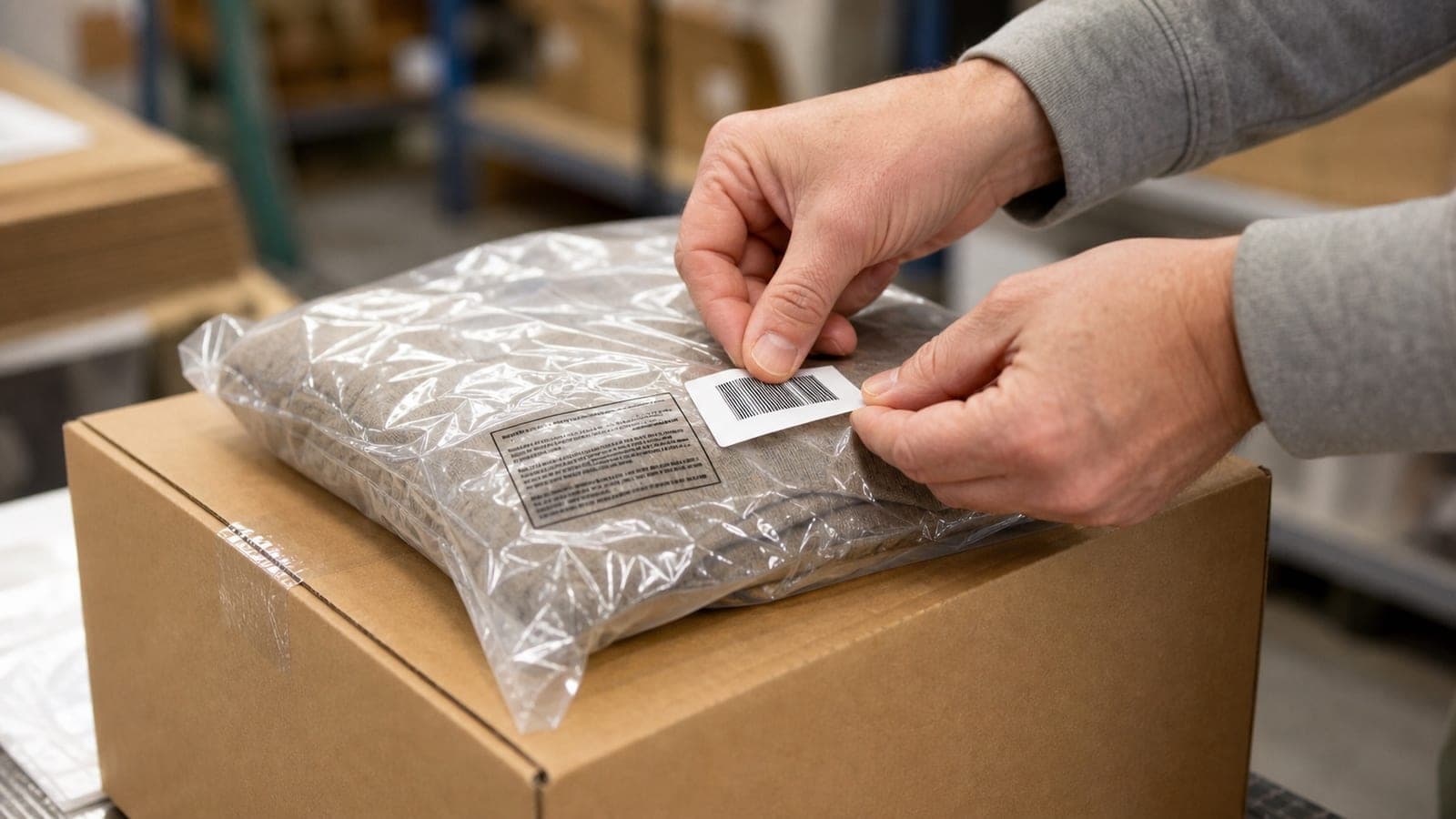
Amazon requires a suffocation warning printed on any poly bag with a 5-inch or larger opening on any side (this threshold, and the general child-safety warning requirement, mirrors the standard followed across US retail and is not an Amazon-only rule). Since most bags and many hats are packed in poly bags well over that size, this applies to the majority of bag/hat listings, not just a few edge cases. The wording needs to be legible, in a color that contrasts with the bag, and cover the standard warning language (that the bag is not a toy, should be kept away from children and cribs, and similar). A factory used to generic export packaging will often default to a plain, unprinted poly bag — you need to specify the warning requirement explicitly in your packaging spec, not assume they already build it in for Amazon orders.
FNSKU / barcode label placement
If you're using Fulfilled by Amazon, every unit needs an FNSKU barcode label — either applied by the factory before shipment (you send the label file and the factory applies it during packing, which is far cheaper than paying Amazon or a prep center to do it after arrival) or handled through Amazon-generated barcodes if the product already carries a scannable manufacturer barcode and you've opted into that program. The label needs to go on a flat, visible surface, not folded over an edge or placed where it will be covered by the poly bag's own printing or a hangtag. It also needs to be applied so it doesn't obscure any existing manufacturer barcode underneath, since a scanner picking up two conflicting barcodes on the same unit is a common cause of receiving errors at the fulfillment center. Send the factory a physical sample of exactly where you want the label placed during the pre-production sample round — describing it in an email is not precise enough.
Carton marking for FBA inbound shipments
FBA inbound cartons need Amazon's own shipment labels (generated from your Seller Central shipping plan) applied to the correct face of each carton, plus accurate carton contents — the actual unit count and SKU mix inside each box has to match what you declared when you created the shipment, down to the carton. A factory that's used to general wholesale carton marking (PO number, item number, carton count) will often not apply Amazon's shipment labels correctly on their own, since those labels are generated per shipment plan and need to be sent to the factory as files close to shipment time, not baked into the packaging spec months earlier. Confirm with the factory who is applying these labels — you, a freight forwarder, a prep center, or the factory itself — before the cartons are packed and sealed, because re-opening sealed export cartons to fix a labeling mistake is expensive and slow.
Common Factory Mistakes That Cause Amazon Inbound Rejections
| Mistake | Why It Happens | Typical Result |
|---|---|---|
| Mislabeled or mismatched carton contents | Factory packs by their own carton logic, not the exact SKU/quantity breakdown your shipment plan requires | Receiving discrepancy at the fulfillment center, delayed inventory, sometimes a short-ship or overage fee |
| Missing prep entirely | Factory ships "standard export ready" goods assuming a prep center or the seller will handle FBA-specific prep | Shipment rejected at receiving or diverted to a paid prep service, adding cost and days of delay |
| Wrong poly bag thickness or missing suffocation warning | Factory defaults to their standard poly bag spec, unaware of the warning-label or thickness requirement | Compliance flag, potential listing suppression, or a costly repack before the shipment is accepted |
| FNSKU labels applied over existing barcodes or on folded edges | No physical placement sample was approved before mass production | Scan errors at receiving, units held or returned as unsellable inventory |
| No test report on hand when a listing is flagged | Factory was never asked for testing during sourcing, and doesn't proactively test unless required | Listing suspended while documentation is chased down after the fact, instead of ready in advance |
Nearly all of these trace back to the same root cause: the factory was vetted and briefed as if this were a generic wholesale order, and the Amazon-specific requirements were assumed rather than specified. A factory that has genuinely fulfilled Amazon-bound private label orders before will ask you these questions themselves during the quoting stage — that's usually a good sign you're not the one who has to catch every detail.
A Practical Checklist Before Placing Your First PO
- Ask directly whether the factory has produced for Amazon FBA/private-label sellers before, and if so, ask for a reference or example of the packaging they used (not the product design — just the packaging and labeling approach).
- Request whatever testing reports exist for your product category, and if none exist yet, get a written quote and timeline for the specific tests you need before production starts, not after.
- Put the poly bag suffocation warning requirement in writing in your packaging spec, including the bag opening size, rather than assuming the factory's default poly bag already meets it.
- Confirm exactly who applies the FNSKU label and where — factory, freight forwarder, or third-party prep center — and approve a physical placement sample before mass production.
- Confirm who applies Amazon's shipment/carton labels and when, since those come from your Seller Central shipping plan and typically can't be finalized until close to ship date.
- Ask if the factory can supply material safety documentation (restricted substances testing) for any coated, printed, or metal-hardware components, especially if you'll be selling in the US or EU.
- If your product could reasonably be marketed to children, raise the CPC question explicitly rather than assuming it doesn't apply to your SKU.
None of this replaces normal factory vetting — production capability, sample quality, pricing, and lead time still matter as much as they always did. It's an additional layer specific to selling through Amazon, and it's cheaper to work through in a quoting email than to discover it after a container of finished goods is sitting in an FBA receiving queue.
Frequently Asked Questions
Does a factory need a BSCI or SEDEX audit to sell into Amazon FBA?
No — Amazon doesn't require a social-compliance audit as a condition of selling a product through FBA. Those audits are useful for brand due diligence and for retailers who require them contractually, but the documentation that actually matters for Amazon-facing sales is product testing, material safety data, and correct packaging/labeling prep, which a social-compliance audit doesn't cover.
What size poly bag actually needs the suffocation warning?
The commonly applied threshold is a bag with any single dimension or opening of 5 inches or more. Most bag and hat packaging falls well above that size, so treat the warning label as the default requirement for this category rather than an exception, and confirm it explicitly in your packaging spec with the factory.
Can the factory apply FNSKU labels themselves, or does that have to happen after the goods arrive?
Factories can apply FNSKU labels during packing if you send them the label file (or the correct barcode setup) ahead of production, and this is almost always cheaper and faster than paying a prep center or Amazon to apply labels after inbound receiving. Confirm the exact placement with a physical pre-production sample, since a poorly placed label is one of the more common causes of receiving errors.
What supplier certifications are required to export a children's product to the US and sell it on Amazon?
Not the ones most suppliers lead with. ISO 9001 and BSCI cover quality process and labor conditions respectively, and neither satisfies US children's product law. What is actually required is third-party testing at a CPSC-accepted laboratory against the applicable rules (lead, phthalates, small parts, and ASTM F963 where the item is a toy), a Children's Product Certificate issued by the US importer on the strength of those test reports, and a permanent tracking label on the product and packaging. Amazon may additionally ask to see the test reports and certificate if a listing is flagged, but the legal requirement exists whether or not Amazon asks.
Does the factory issue the Children's Product Certificate?
No. The CPC is a declaration by the US importer or domestic manufacturer — in a private-label arrangement, that is you, not the factory. The factory's role is to supply accurate material and production information and to have the product tested at a CPSC-accepted lab, or to support your own testing arrangement. If a supplier offers to hand you a completed CPC with their name on it, that is a sign they have misunderstood the requirement rather than a shortcut worth taking.
What's the single biggest difference from sourcing for a non-Amazon store?
Amazon's receiving and compliance systems are largely automated and unforgiving of small mismatches — a wrong carton count, a missing warning label, or an unavailable test report causes a concrete rejection or suspension rather than a conversation with an understanding buyer. Building the documentation and prep requirements into your factory brief from the start, rather than treating them as an afterthought, is what makes the difference on a first order.
Sourcing your first Amazon private-label bag or hat order and want a factory that already understands FBA prep and documentation requirements? Get in touch and we'll walk you through what we can provide before you place a deposit. If you're also finalizing branded packaging for the order, our packaging and private label options guide covers poly bags, hangtags, and carton marking in more detail.