How to Audit a Bag & Hat Factory: A Buyer's Guide to Avoiding Costly Mistakes
Last updated: August 2026
A factory audit — whether you fly out to walk the floor yourself or hire a third-party firm to do it for you — is the single best way to confirm a supplier can actually deliver what their sales team promises. It's also the step buyers most often skip or rush, because it takes time and costs money before you've placed an order. Here's what an audit should actually check, and the mistakes that let unqualified suppliers slip through.
Confirm You're Auditing a Factory, Not a Trading Company
The most common and most costly mistake is auditing an address that turns out to be an office, not a production facility. Trading companies and sourcing agents often present themselves as manufacturers, and some will arrange a visit to a factory they've simply partnered with for that one tour. Ask direct questions before you book the trip: how many production lines does this specific address run, how many workers are on payroll here, and can they show utility bills or a business license tied to that exact site. A real manufacturer answers these without hesitation; a middleman gets vague.
What to Check on the Production Floor
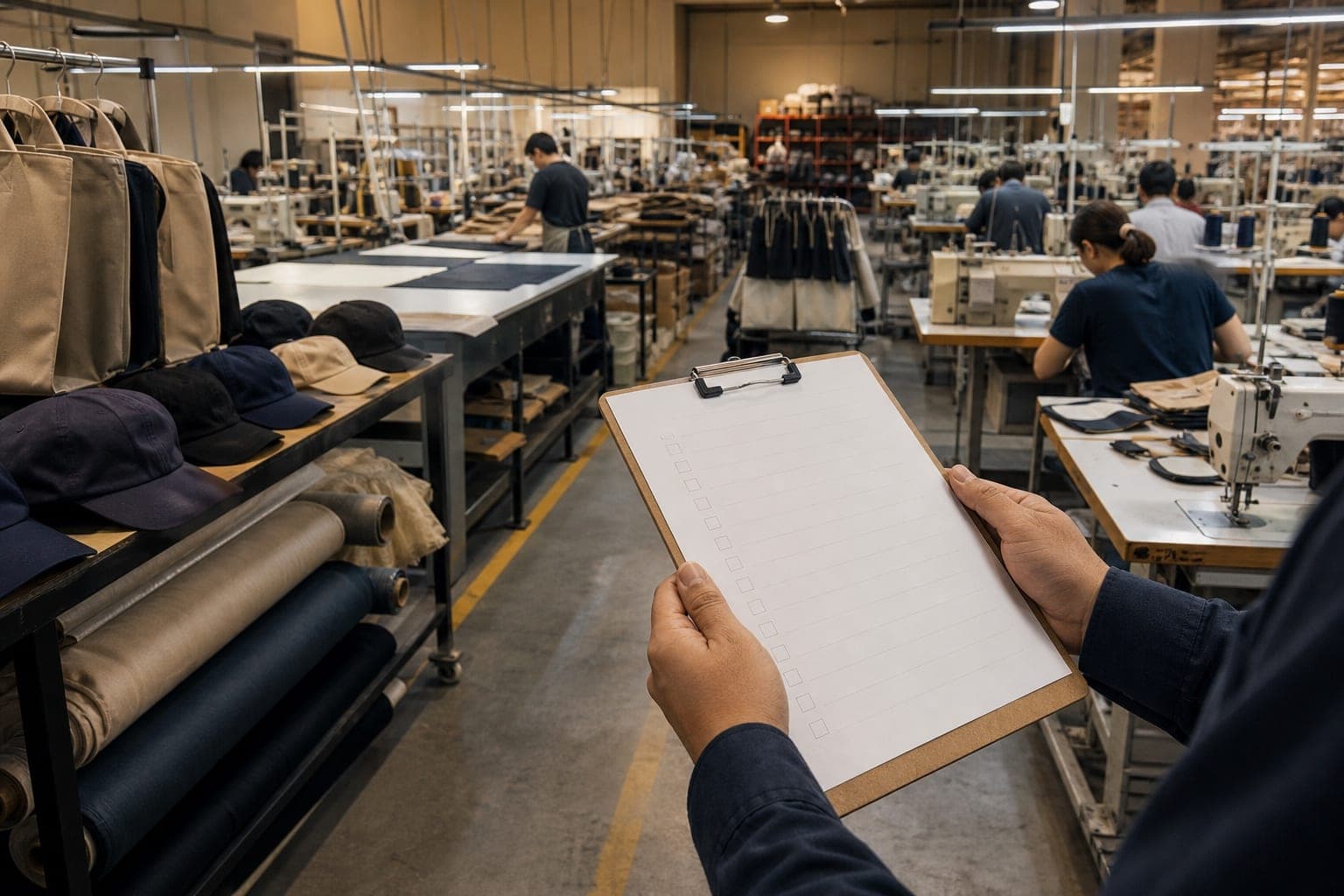
Walking the floor is where most of the useful information actually comes from — not the conference room. A few things worth looking at directly:
- Machine count vs. claimed capacity — count sewing stations and cutting tables and do rough math against the monthly output they quoted you. A factory claiming 50,000 units/month with 15 sewing machines is not being straight with you.
- What's actually being produced right now — ask to see the products currently on the line and match them against your category. A hat factory should have hat-specific equipment (crown formers, brim presses); a factory only running bags with no headwear tooling can't credibly quote you a cap order at factory pricing.
- In-house departments — cutting, sewing, embroidery/printing, and QC ideally sit under one roof. If embroidery or printing is subcontracted out, that's not disqualifying, but it adds a handoff that affects lead time and quality consistency — ask directly rather than assuming.
- Material storage — a warehouse with organized, labeled fabric rolls and hardware bins suggests a factory that runs multiple client orders in parallel without mixing them up. Disorganized storage is a preview of how your order will be handled.
Documents Worth Requesting Before You Commit
A legitimate factory won't hesitate to share the following, and reviewing them before your visit lets you spend on-site time on things you can't verify remotely:
- Business license, matched to the address you're visiting
- Export license and recent shipping records (bills of lading with client names redacted, if needed)
- Current certifications — BSCI, SEDEX SMETA, ISO 9001 — with certificate numbers you can independently verify against the issuing body's database, not just a PDF badge on their website
- A client reference list, or at minimum a willingness to let you contact one existing client in a market similar to yours
Common Red Flags We Tell Buyers to Watch For
| Red Flag | Why It Matters |
|---|---|
| Sample quality is noticeably better than what similar clients report receiving in bulk | Suggests bulk production isn't held to the same standard as the sample — ask specifically how sample and bulk QC differ |
| Reluctance to schedule an unannounced or lightly-announced visit | Legitimate factories rarely object to short-notice visits; heavy scheduling requirements can be used to prepare a "showroom" version of the floor |
| Certificates that can't be verified against the issuing body's public database | Certificate fraud exists — a real BSCI or ISO 9001 certificate has a number you can look up independently |
| Pricing significantly below every other quote for the same spec | Often means a substituted material, subcontracted production, or a quote that will change once you've committed |
| No clear answer on where your specific product category is actually made | A common tell for a trading company routing your order through a subcontractor you'll never see |
If You Can't Visit in Person
A live video walkthrough is a reasonable substitute for a first order, especially for smaller trial quantities. Ask for an unscripted call rather than a pre-recorded video — request to see specific things in real time (a particular machine, a specific rack of in-progress orders, the QC station) so you're not just watching a curated tour. For larger or repeat orders, a paid third-party audit firm (the same firms that run pre-shipment inspections) can conduct a formal factory audit on your behalf and issue a report, which is worth the cost once order volume justifies it.
Frequently Asked Questions
How much does a third-party factory audit typically cost?
Third-party audit firms typically charge a per-day fee for a single auditor's visit, which usually covers one facility in one day. It's a worthwhile expense once you're planning a large or recurring order, but for a first small trial order, your own video walkthrough plus document verification is often enough to get started.
Should I announce my visit in advance or show up unannounced?
A short notice window (a day or two) is a reasonable middle ground — enough for the factory to make sure the right staff are available to answer your questions, but not enough time to substantially stage the floor. Be cautious of any factory that insists on weeks of advance notice for a routine visit.
Is it a problem if some processes, like embroidery, are subcontracted?
Not necessarily — many factories subcontract specialized processes to dedicated specialists rather than running underused equipment in-house. What matters is transparency: a factory that tells you upfront which steps are subcontracted, and can name the partner, is being straightforward. One that implies everything happens in-house when it doesn't is the actual problem.
Can I verify a BSCI or ISO 9001 certificate myself?
Yes. BSCI ratings are searchable through amfori's platform with the factory's registration details, and ISO 9001 certificates can be checked against the issuing certification body's own registry using the certificate number. Always ask for the certificate number itself, not just a logo or scanned badge, and check it independently rather than taking the factory's word for it.
Sourcing bags or hats and want to know exactly what an audit of our own facility would show? Get in touch — we're happy to arrange a video walkthrough or an in-person visit before you commit to an order.